Showing posts with label #KatherineHensel. Show all posts
Showing posts with label #KatherineHensel. Show all posts
Wednesday, April 24, 2019
Finishing up
Almost there! Me being me, I won't turn it in until right before it's due because there is always something to tweak. Like Lizzy said, with big papers it never really feels finished. That said, I am starting to relax about it. The poster is in, I gave my little talk, and now it's just reading for grammar and adding in a few more connecting sentences. Then the poster session. Though it's been difficult focusing on this and other class work, I'm already transitioning into summer mode and have been studying for my internship (got to learn those birds--already found a place that releases California Condor near where I'll be!!).

Wednesday, April 3, 2019
Draft Revisions & Poster
While I'm waiting on feedback from my advisers and dad on the draft I've been adding in Dr. Lent's feedback and just reading through it myself periodically. I hope to spend some quality time with Turabian this weekend or early next week to make sure all my citations are fine. I still need to finish the appendices, but that shouldn't take too long as I just have images.
Poster is going well, I've started adding in text and made sure the formatting looks good. I've tweaked the colors slightly as well. My biggest concern is photos, but I am hoping I will have time to drive over to Seneca Falls to take pictures of all the sites myself on the 14th. I have some now that should be fine, except I need to ensure the dpi works, especially on one of them. I just think it will be easier if I can list everything as "taken by author" and ensure the image quality. Adding in those photos will only take a little bit of editing on the poster. I also need to update the google maps image to include an additional location and draw in the route. That should get done this weekend though.
It's weird to think I'm going to be done with all my undergrad classwork in just about a month.
Poster is going well, I've started adding in text and made sure the formatting looks good. I've tweaked the colors slightly as well. My biggest concern is photos, but I am hoping I will have time to drive over to Seneca Falls to take pictures of all the sites myself on the 14th. I have some now that should be fine, except I need to ensure the dpi works, especially on one of them. I just think it will be easier if I can list everything as "taken by author" and ensure the image quality. Adding in those photos will only take a little bit of editing on the poster. I also need to update the google maps image to include an additional location and draw in the route. That should get done this weekend though.
It's weird to think I'm going to be done with all my undergrad classwork in just about a month.
Thursday, March 21, 2019
Update 4
I have continued to write. Now I am bringing my sections on religion, transportation, and activism more into my tour route. I have a lot of writing I still need to get done by Thursday as I was away during spring break and didn't work on any school work then (the break was well spent hiking though). However, I have a good idea of what I will be incorporating and where. As soon as I submit the draft Thursday I will be transitioning to writing the poster sections. I haven't developed my appendices yet, so that my come as I am working on the poster bits as well.
Wednesday, February 27, 2019
Third Update of the Semester
The last few weeks I have started developing the tour route and writing about the different historic houses and buildings along the route. Right now it is probably too long but I plan to talk to Denise about it next week and get feedback. Next step is to find out how I want to add information between the sites as we walk, and figure out what additional information I will need to research for that.

This week I have also started to develop my poster and I have a pretty good idea on how I want it set up and the images I'll want to use. I'll need to reach out to the the Seneca County Historical Society or see if the NPS has higher quality images I can use for my poster.

Thursday, February 14, 2019
Update 2
I've kept working on research and writing. I got in contact with Mason and will be looking through his sources, and I got some suggestions from Dr. Brown for some additional resources as well. I plan on continuing to research and write and then in early March, Denise and I will start discussing tours and interpretation at the park in more detail. This Friday, Sunday, and Monday should be productive thesis days for me. The first few weeks I had a pretty good schedule going for working on thesis, but have fallen out of that as other assignments have come up. So during the next few weeks a goal of mine is to get back into a more established schedule.
Wednesday, January 30, 2019
Back to School
I was a little nervous about how I was progressing in the semester until I saw everyone else worrying about how it's only week 3 and they already feel like they're behind! Though by this point you think I would be used to it. The writing has been okay, I'm working through it, though it will definitely be a little disjointed right now until I get a better idea of how I would actually like to structure my research content. Right now I am working on my introduction section and a section on religion and the Erie Canal. This weekend I am hoping to read "Low Bridge: Folklore and the Erie Canal" by Lionel D. Wyld, depending on the progress of that I will also pick up "The Psychic Highway: How the Erie Canal Changed America" by Michel T. Keene. Both get into some of the more general history of the canal. I'm not sure if I'll read all of Low Bridge, as the first few chapters are more relevant for my studies than the second half of the book. The Psychic Highway looks at a lot of the social impacts I am interested in.
Wednesday, December 5, 2018
Winter Writing
During winter break I am going to dedicate a lot of time to do a deep-dive on research about the history of the Erie Canal and the impacts it had on the Seneca Falls region. I will specifically be researching how it impacted religion, the movement of ideas, the movement of people, economics, and the environment. During this research, I'm also going to start throwing around ideas for a tour/educational program/lecture that I have been invited to present in Spring at the park. I'm planning to spend 10-20 hours a week during the break on my thesis, but the quieter weeks may see a few more hours.
I am also planning to make a few trips to Seneca Falls Women's Rights National Historic Park to get the lay of the land and meet some of the people I could be working with. On January 5th there is an event going on at Seneca Falls called "The Preamble and the Enlightenment" which is part 2 of a 6 part series examining the Declaration of Sentiments which I plan to attend (and may bring some family too).
I am also planning to make a few trips to Seneca Falls Women's Rights National Historic Park to get the lay of the land and meet some of the people I could be working with. On January 5th there is an event going on at Seneca Falls called "The Preamble and the Enlightenment" which is part 2 of a 6 part series examining the Declaration of Sentiments which I plan to attend (and may bring some family too).
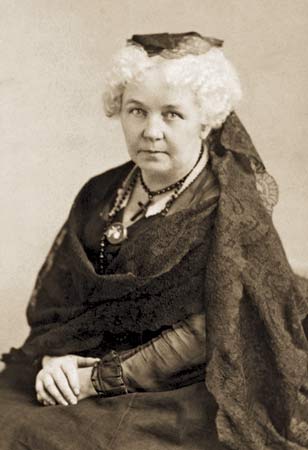 |
| Elizabeth Cady Stanton, the principal author of the Declaration of Sentiments. Photo from Wikipedia. |
Thursday, November 29, 2018
Evolving Thesis
After speaking with Denise from Seneca Falls Women's Rights National Historic Park my topic has changed from the confluence of science and history to looking at how the Erie Canal impacted the movement of people and how that led to the movement of ideas and reform in Seneca Falls. I'm going to be researching the topic thoroughly and providing them with my thesis at the end so they may use it to develop an educational program and tour. We will discuss next week the possibility of pairing me with a ranger so I can work with them during my thesis to begin making the program and tour. So while I have moved from science to history, my goal of creating educational programming has remained.
We did also discuss the idea of looking at how the Erie Canal impacted the biodiversity of Seneca Falls, and I may incorporate that, but we generally moved away from it to keep the scope of the project within what I can manage. Depending on how things progress, I may choose to look into that as well. I'm considering writing about both the ecology as well as reform history and then just developing a program/tour on one of the topics.
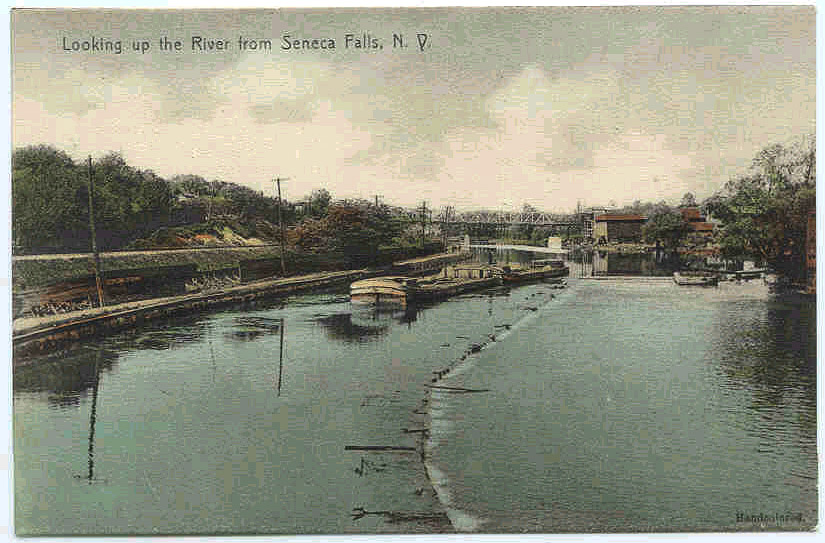 |
| Erie Canal at Seneca Falls. Image from http://www.nycanals.com/Seneca_Falls |
We did also discuss the idea of looking at how the Erie Canal impacted the biodiversity of Seneca Falls, and I may incorporate that, but we generally moved away from it to keep the scope of the project within what I can manage. Depending on how things progress, I may choose to look into that as well. I'm considering writing about both the ecology as well as reform history and then just developing a program/tour on one of the topics.
Friday, November 9, 2018
What I have learned so far
I have been reading a lot about science education in a broad capacity. Many of the articles discuss the importance of setting for children to learn. In particular, how just being in an out-of-classroom location may help students stay engaged as well as how more specific experiences can broaden how students make connections. I've also learned about how active learning often promotes working in groups. One article was about how nature walks allow for a family to work through an idea together and occasionlly helps different family units come together in a discussion or activity. Other articles looked at how scientists and public educators can come together in collaboration. These discussed at how scientists can ensure the public is getting up to date material as well as how museum professionals can help reframe that information out of scientific jargon for a broader audience.
The next type of article I will be searching for and reading through is how living history museums and other historic sites have introduced science education and in particular the challenges they face. I will also be looking for articles related to effective signage for nature trails. Throughout our coursework, we have discussed how didactic signs have been used and are used within museum walls and I am curious to see if there is a significant difference of opinion for nature trails.
 |
| Students on a nature walk. From savorsnoqualmievalley.org |
Thursday, October 4, 2018
Kate's Research Question
How can Historic Sites pull upon fields outside of history, like biology, to develop a better education experience for their visitors?
The goal of my research is to develop an educational experience that incorporates biology into the Seneca Falls Women's Rights National Historical Park in order to broaden the interests of the general public, provide more options for the type of experience guests can have when visiting, and show how biology and history are connected fields and how they both impact our culture. The exact form of the education experience has not been decided on, as it is dependent on what the Historic Park is looking for. As such, my research question will be adjusted to the specific problems and questions posed by the type of education outreach I settle on. The topic will relate to invasive species and the impact that has on commerce and culture. If this is done through the lense of a general view, or more specifically through bird or plants will be decided on what The Historic Park would like to develop.
Why it important to combine biology and history?
We tend to think of these topics as being separate, but our environment influences our history and our history alters our environment. How did the environment look during Stanton’s time? How did this impact her life?
Why is it important we talk about invasive species?
Invasive species alter the biodiversity of a region and this can impact the parts of the economy reliant on local ecology as well as altering landmarks and sites of cultural importance.
The goal of my research is to develop an educational experience that incorporates biology into the Seneca Falls Women's Rights National Historical Park in order to broaden the interests of the general public, provide more options for the type of experience guests can have when visiting, and show how biology and history are connected fields and how they both impact our culture. The exact form of the education experience has not been decided on, as it is dependent on what the Historic Park is looking for. As such, my research question will be adjusted to the specific problems and questions posed by the type of education outreach I settle on. The topic will relate to invasive species and the impact that has on commerce and culture. If this is done through the lense of a general view, or more specifically through bird or plants will be decided on what The Historic Park would like to develop.
Why it important to combine biology and history?
We tend to think of these topics as being separate, but our environment influences our history and our history alters our environment. How did the environment look during Stanton’s time? How did this impact her life?
Why is it important we talk about invasive species?
Invasive species alter the biodiversity of a region and this can impact the parts of the economy reliant on local ecology as well as altering landmarks and sites of cultural importance.
Thursday, September 27, 2018
Research Underway
The process of research has really started up! With the focus of education within the National Park Service, I took to The Journal of The National Council on Public History to start. In 2016 they had a special edition for November that dealt with the Park's centennial. In this volume, a wide range of topics was discussed, including education, management, archeology, and outreach. As my research is focused on public education and interaction I read "National Parks for New Audiences: Diversifying Interpretation for Enhanced Contemporary Relevance" by Daniel E. Coslett and Manish Chalana, as well as "Resuscitating the Promise: Reflections on Implementing Innovative and Collaborative History from the Nation's First National Historic Site" by Margo Shea, Maryann Zujewski, and Jonathan Parker. I had originally been planning on doing a self-guided or ranger-led tour experience, and I still might, but "Resuscitating the Promise" has me considering creating a research question and project that relates to broader community work. In this article, the Salem Maritime National Historic Site staff teamed up with local educators to create a program for teachers to experience the park so that can integrate what they learned into the classroom and hopefully bring the class to the park. I will need to spend more time researching the near and far goals of the National Park System, and Seneca Falls especially, to determine how to proceed.
Throughout my research, I have noticed the prevalence of case studies in almost all of the articles. I have also noticed the structure of the article is often framed around the case studies. With the end goal of writing my own thesis, I have been paying much closer attention to the structure and tone people use. It has been interesting how the tone of articles change depending on how involved the author was in the topics being discussed. In "National Parks for New Audiences" the authors were more disconnected and examining what others were doing while the authors of "Resuscitating the Promise" were directly involved in the project they were discussing.
References:
Shea, M., M. Zujewski, and J. Parker. "Resuscitating the Promise: Reflections on Implementing Innovative and Collaborative History from the Nations First National Historic Site." The Public Historian 38, no. 4 (2016): 129-48. doi:10.1525/tph.2016.38.4.129.
 |
| The Public Historian Volume 38 Number 4 Cover Volume I got my articles from this week |
Throughout my research, I have noticed the prevalence of case studies in almost all of the articles. I have also noticed the structure of the article is often framed around the case studies. With the end goal of writing my own thesis, I have been paying much closer attention to the structure and tone people use. It has been interesting how the tone of articles change depending on how involved the author was in the topics being discussed. In "National Parks for New Audiences" the authors were more disconnected and examining what others were doing while the authors of "Resuscitating the Promise" were directly involved in the project they were discussing.
References:
Coslett, D. E., and M. Chalana. "National Parks for New Audiences: Diversifying Interpretation for Enhanced Contemporary Relevance." The Public Historian38, no. 4 (2016): 101-28. doi:10.1525/tph.2016.38.4.101.
Coslett, D. E., and M. Chalana. "National Parks for New Audiences: Diversifying Interpretation for Enhanced Contemporary Relevance." The Public Historian38, no. 4 (2016): 101-28. doi:10.1525/tph.2016.38.4.101.
Coslett, D. E., and M. Chalana. "National Parks for New Audiences: Diversifying Interpretation for Enhanced Contemporary Relevance." The Public Historian 38, no. 4 (2016): 101-28. doi:10.1525/tph.2016.38.4.101.Shea, M., M. Zujewski, and J. Parker. "Resuscitating the Promise: Reflections on Implementing Innovative and Collaborative History from the Nations First National Historic Site." The Public Historian 38, no. 4 (2016): 129-48. doi:10.1525/tph.2016.38.4.129.
Shea, M., M. Zujewski, and J. Parker. "Resuscitating the Promise: Reflections on Implementing Innovative and Collaborative History from the Nations First National Historic Site." The Public Historian38, no. 4 (2016): 129-48. doi:10.1525/tph.2016.38.4.129.
Shea, M., M. Zujewski, and J. Parker. "Resuscitating the Promise: Reflections on Implementing Innovative and Collaborative History from the Nations First National Historic Site." The Public Historian38, no. 4 (2016): 129-48. doi:10.1525/tph.2016.38.4.129.
Tuesday, September 11, 2018
Kate's Thesis Ideas: Nature at Seneca Falls
For my thesis I would like to partner with the Women's Rights National Historical Park in Seneca Falls. As I am primarily interested in educational outreach and programming, I would like to work with them to improve existing, or to create new, educational experiences for their visitors. Depending on the park's needs this could go in many different directions.
I am especially interested in developing a ranger guided tour or self guided tour about the nature near the historic home of Elizabeth Cady Stanton. I have been considering making didactic text displays or a brochure discussing the local birds. This semester I am taking an ornithology class and I am involved in Dr. Pagano's research lab studying migratory songbird nutrition in the local area. I could draw upon these experiences and additional research to develop a birding guide for the Seneca Falls region. Montezuma National Wildlife Refuge is nearby to the historic park and may be another useful resource to draw upon. Another idea is to have a similar guided tour (either self or ranger-led) but for the local fauna. In addition to researching the local plants for identification, I would connect the plants to their historic importance. I could look at the native versus invasive species and how invasive species were introduced and the impact that had on the ecology and economics of the area. Another point of interest is looking at how plants were used medicinally and culturally during Elizabeth Cady Stanton's lifetime, including any direct connections to her and other contemporary women's rights activists.
I am especially interested in developing a ranger guided tour or self guided tour about the nature near the historic home of Elizabeth Cady Stanton. I have been considering making didactic text displays or a brochure discussing the local birds. This semester I am taking an ornithology class and I am involved in Dr. Pagano's research lab studying migratory songbird nutrition in the local area. I could draw upon these experiences and additional research to develop a birding guide for the Seneca Falls region. Montezuma National Wildlife Refuge is nearby to the historic park and may be another useful resource to draw upon. Another idea is to have a similar guided tour (either self or ranger-led) but for the local fauna. In addition to researching the local plants for identification, I would connect the plants to their historic importance. I could look at the native versus invasive species and how invasive species were introduced and the impact that had on the ecology and economics of the area. Another point of interest is looking at how plants were used medicinally and culturally during Elizabeth Cady Stanton's lifetime, including any direct connections to her and other contemporary women's rights activists.
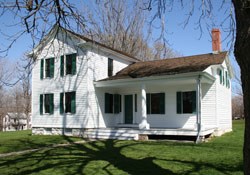 |
| Elizabeth Cady Stanton House Source: National Park Service |
Wednesday, September 5, 2018
Why I chose Museum Studies and Biology
Hello, my name is Katherine Hensel, and I am beginning my thesis journey, aka beginning the end of my college experience. Even while applying to colleges I knew I wanted a career as an Interpretive Park Ranger. This goal led me to choose to major in Biology and Museum Studies with a History minor at RIT. I have always been passionate about history and the environment. Hiking and camping have been a constant in my life, first with family and friends, and then later with the RIT Outing Club. I have been visiting National Parks for as long as I can remember and I want to contribute to "America's Best Idea," as Ken Burns put it. At RIT, the Museum Studies program have enhanced and developed my interest in education and interpretation. The faculty have pushed me from just wanting to understand and share, to pursuing the best educational methods in order to communicate ideas with the public.
 |
| 2008 Bryce Canyon National Park |
 |
| 2010 Arches National Park |
 |
| 2013 Yellowstone National Park |

 |
| 2014 Grand Canyon National Park |

 |
| 2015 Jewel Cave National Monument |

 |
| 2015 Mount Rushmore National Memorial |

Subscribe to:
Posts (Atom)