The semester is at the end and intersession break is just around the corner. The goal of my research during the intersession is to gather more data of Deaf Studies archives; to research data of deaf institutions with deaf studies’ archives, to develop survey questions for future participators’ assessment needs, and to collect data through video call interviews from institutions for the Deaf’s archive faculty and volunteers based on their assessment needs. Overall, I will be developing basic structure designs and online training guidelines to fulfill faculty and volunteers’ assessment needs.
Showing posts with label archive. Show all posts
Showing posts with label archive. Show all posts
Wednesday, December 16, 2015

Thursday, December 10, 2015
Two-Pronged Approach
On November 30, I had an opportunity to visit Vintage Pinball in Del Ray, Florida. It is a commercial establishment with coin operated machines (mostly pinball) from the 1960s and 1970s. Some of the machines are for sale. Inside there are three rooms filled with pinball machines set to free-play, about 30 in all. Due to family obligations I wasn't able to spend as much time as I would have liked, but for $10.00 a customer can spend as much time as they like there (even come and go). Being exposed to machines and actually being able to play them is far superior to reading about them in books. When you are a player you get the full experience and see the moving parts in action, including how the ball interacts with the artwork-covered environment. There are subtle details that are easy to miss, and some of the mechanisms in pinball machines are so unique, it is hard to understand them from text alone. From this experience, I have concluded that for any machine I want to examine in depth, I should have at least some hands on experience. If that is not possible, I will look online to see if there are any videos of people playing the machine. I am also curious about people's first-time impressions and reactions to machines when they are released, but this information could be tricky to come by for half-century old machines!
The past two weeks have been packed with projects, papers, and presentations. Even when I was traveling, I was working on assignments. I am looking forward to intercession, not because I won't have to do work (on my thesis), but because I can really focus on it without competing coursework for a few weeks! There is another important project I am working on concurrently, outside of RIT, but at least it is somewhat related to my research. I also hold an internship at The Strong, where I am currently working every Friday in the Archives.
During the intercession in December and January, I will spend most of my time doing collections and archival research at The Strong National Museum of Play, where many of my pinball sources come from. I have been thinking about which machines in particular will be good subjects for my thesis. The Strong has many machines, but not all of the ones I would like to examine. That is where the library and archives will come in handy! Monday through Thursday (with the exception of holidays), I would like to put in 3.5 hours of thesis research, followed by 4 hours of internship work. (Fridays will remain the same, with 7.5 hours of internship work.) At first I thought it would be excessive, but I have a long way to go! It is better to put the time in now than to wish I had later.
Since I do not have a lot of prior knowledge in women's studies, I will also need to begin reading some current texts as well as foundation texts that inform the field today. I might have a better idea which sources best suit my needs once I meet with my advisors. Their suggestions may help me narrow my scope and choose key topics that will point to where I need to look. I will do this reading in the evenings and on weekends. Once I have gathered enough pinball-related material for my thesis, I can focus more heavily on women's studies. The more I think about it, it seems a bit "backwards"-- how can I examine the material with a critical feminist lens before having fully developed one? Since I will not be able to spend a lot of time at The Strong during Spring semester, I have to get that time in now.
My goals for intercession are to "complete" most of my pinball-related research and read at least one long women's studies text.
My goals for intercession are to "complete" most of my pinball-related research and read at least one long women's studies text.
In addition, I have come up with a primitive overall plan of work:
December 21-31: Research at The Strong - Books and Magazines, Collections
January 1-15: Blogs, Magazines, Articles, Exhibits Research, Finalize Outline
January 16-31: Update outline. Women’s Studies Research - Books & Scholarly Articles
February 1-15: Update outline. Begin Rough Draft using research notes.
February 16-29: Primary and Secondary Read Draft, Feedback, Revision
March 1 -15: Primary and Secondary Read Draft, Feedback, Revision
March 16-31: (Spring Break) Travel if necessary, otherwise continue writing.
April 1-10: Primary and Secondary Read Draft, Feedback, Final Revision
April 12-16: Finishing Touches on Thesis (DUE WEEK 12 / April 12-16).
Monday, October 5, 2015
Research Question, M.Fanton
I am working on the topic of obsolete electronic storage media because...I want to find out the rates in which obsolescence occurs for various types of media in a comparative study...in order to develop a cost an labor analysis that will inform museum and archive professionals about the optimum time frame in which to create preservation copies of existing storage media in their collections.
Based on this (run-on) statement, I have developed a research question:
Are there obsolescence models and patterns that can predict the optimum time frame in which to actively preserve (that is, to make archival copies of) aging storage media, so that archives and museums can take a proactive rather than reactive approach to their preservation?
Dr. Carroll had a series of follow up questions, such as:
- What is the existing research?
- Does the existing research need to be updated?
- Are there exiting models?
- Will I (the researcher and writer) be providing a series of recommendations?
In class we discussed the potential applications of this research, in which I expressed a desire to take a practical approach rather than a conceptual (only) approach. This will have an effect on my research methodologies and how I design possible recommendations.
In order to proceed, I will need to read current research papers, articles, and books in the field, as well as contact museum professionals at institutions with electronic media in their collections. Dr. Carroll recommended contacting Rebecca Simmons at the RIT Archives.
I may narrow my research to a specific type of media (audio recordings, for example). Although my initial interest was in the preservation of floppy discs (PC games) and video game cartridges, this presents the additional challenge of confronting the tangled webs of intellectual property and copyright law associated with them. I have decided to take a different path so that my research will apply to a broader range of institutions (collections) and increase its potential future use.
Code 42 software company has put together the following infographic for their Crashplan web site (an online data backup service?). Not only does it illustrate my topic, it also contains sources for me to further explore (at the bottom), and points to other considerations I will have to address such as the storage of storage media (conditions) and usage (used regularly or barely touched?).
 |
| I am not endorsing this service, but this presents an example of a form my research might take. |
Thursday, September 3, 2015
Hello, I'm Melissa.
Before I begin posting regularly, I would like to introduce myself. My name is Melissa Fanton, and I am a fourth-year museum studies student at RIT. Since becoming an intern at The Strong National Museum of Play, my interest in Collections Management has blossomed and I hope to pursue a thesis topic related to collections. The collections at The Strong are too interesting not to study in more depth, and their library and archives can provide many high quality sources. Thank you for reading, and stay tuned for more in the coming months.
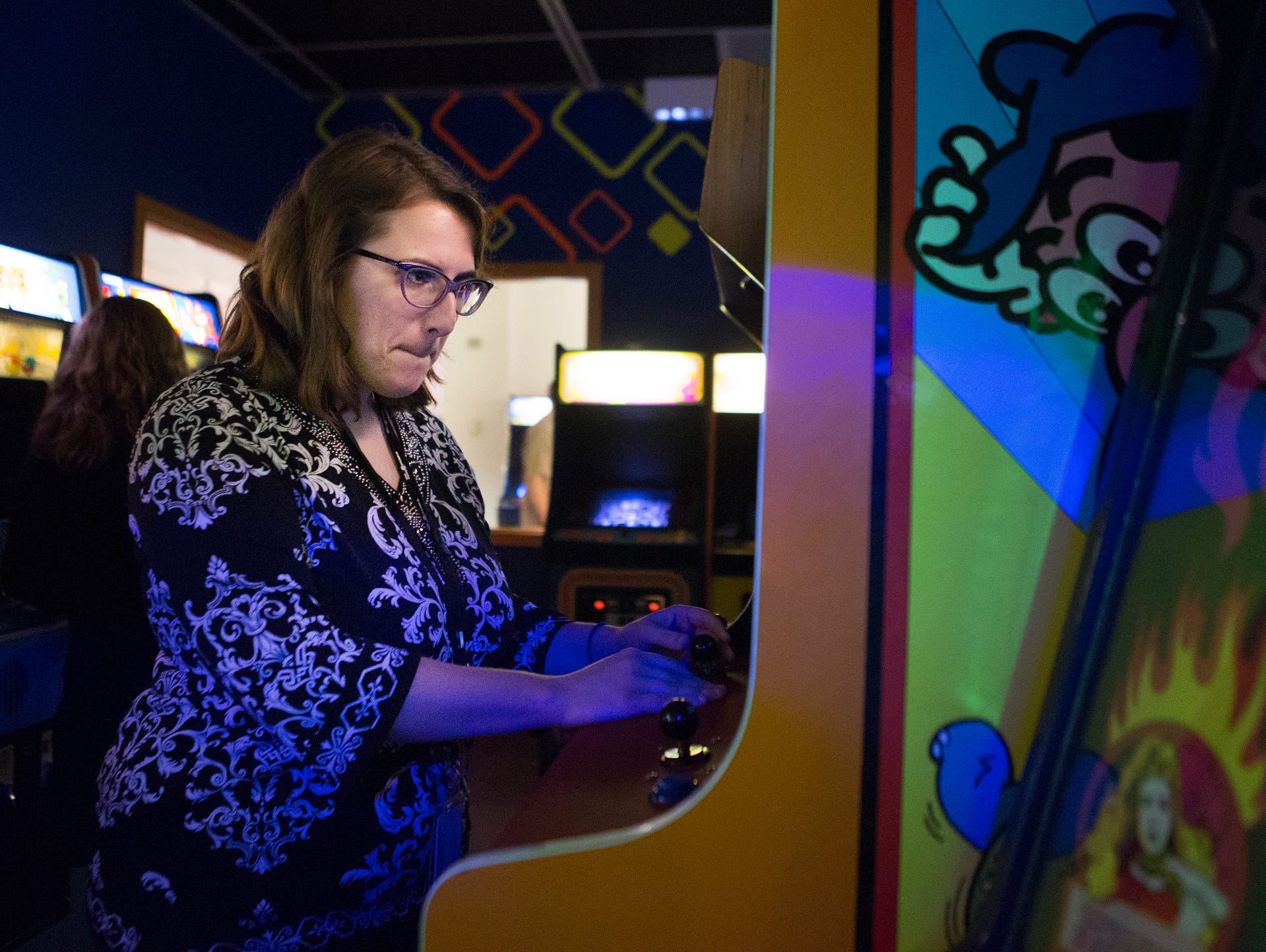 |
| A photograph of me during my internship at The Strong. The image depicts me playing Super Mario Bros. on the day of the World Video Game Hall of Fame induction ceremony. This photograph was taken by RIT alumni Lauren Petracca, staff photographer for the Democrat & Chronicle. From the Democrat & Chronicle, June 4, 2015. Article can be found online here. |
Subscribe to:
Posts (Atom)