Showing posts with label collections. Show all posts

Sunday, February 21, 2016

Reframing Thesis Paper, Deaf Collection and American School for the Deaf

Past few weeks flew by and my thesis paper constantly shifting its focus. I cannot believe the frustration I have with this paper. My goal is to organize a timeline to help me focus more on the thesis and invest more time in researching, organizing and re-formatting the topic.

Since the intercession, the topic paper went from Digital Archive and Curriculum Developing to  Deaf Collections’ Digital Archive and American School for the Deaf (ASD). ASD will be having their bicentennial (200th) celebration in the upcoming April 2017 and their goal is to establish a collaborated digital archive project. My goal with this project is to become involved with the project and do some digitizing, cataloging and to work remotely.

My thesis paper often went out of focus and that encouraged me to visit my advisors and asked for their feedbacks. After few days, with advisors feedbacks and several edits, i still couldn’t change the formats. I revisited and emailed them my several copies of  the first draft paper. Their feedbacks came out and it was still more than i assumed. Hopefully with 2nd paper, the vision might clear up better with developing details, restructuring clearer objectives.

Secondly, the research on the topic, Deaf Collections’ Digital Archive and American School for the Deaf, seem to be more clear point to start but elaborating more on the historical aspects, metadata, reading / research sources will be challenging for me to work with. Other than researching and reading, I'm maintaining contact with my connections, some of the coordinators at ASD, to plan my trip for a upcoming workshop related to ASD's collaborated project.

Thursday, September 10, 2015

Initial Thesis Concept, Melissa Fanton

Magnetic storage media has a short life cycle, but the complexity of its preservation has been an obstacle to creating standard preservation practices, which are still in their infancy. Many museums and archives with magnetic storage media seem to be waiting for the right "conditions" to begin preserving the content stored within (affordable storage, best practices, the right software and hardware), but predicted life cycles for most magnetic storage media are 30 years or less (under optimal storage conditions). Those floppy disks in the collection? They're "dead". Those VHS tapes? They're dead, too. Those video game cartridges? Dead. While paper materials are being digitized to improve accessibility, magnetic media deteriorates, threatening the existence of the content within.

My original goal was to read the current research and construct an argument that there are preservation solutions, we (in the museum field) simply don't prioritize these types of collection items. Museums will often accept these items into their collection without testing them due to time, labor, and equipment limitations (is the data in tact, "uncorrupted", and accessible?).

With a much narrower focus (specific type of media, specific type of institution or collection), I thought I would be ready to begin, however, it just doesn't feel right. A senior thesis isn't just supported by research; it is supported by four years of undergraduate education and other experience. Have I prepared myself to write about such a topic, even from a museum collections intern perspective? In some respects, yes, in others, not at all. My "gut" tells me I will be spending more time educating myself on fundamental concepts related to my topic than doing targeted, in-depth research and writing. Will I be mid-way through the process before my brain finally cries "does not compute!?" Before I make a decision to commit to this topic, I will need to do more research.

Since this idea stemmed from a concern with preserving video game software and hardware in museum collections, I have included the video I will be watching next. The video below is part II of a panel discussion hosted by the Smithsonian American Art Museum "focused on how to conserve and preserve digital media, specifically video games..." One of the members on the panel is J. P. Dyson, Director of the International Center for the History of Electronic Games (ICHEG) and VP for Exhibits at The Strong from The Strong National Museum of Play.


Thursday, September 3, 2015

Hello, I'm Melissa.

Before I begin posting regularly, I would like to introduce myself. My name is Melissa Fanton, and I am a fourth-year museum studies student at RIT. Since becoming an intern at The Strong National Museum of Play, my interest in Collections Management has blossomed and I hope to pursue a thesis topic related to collections. The collections at The Strong are too interesting not to study in more depth, and their library and archives can provide many high quality sources. Thank you for reading, and stay tuned for more in the coming months.

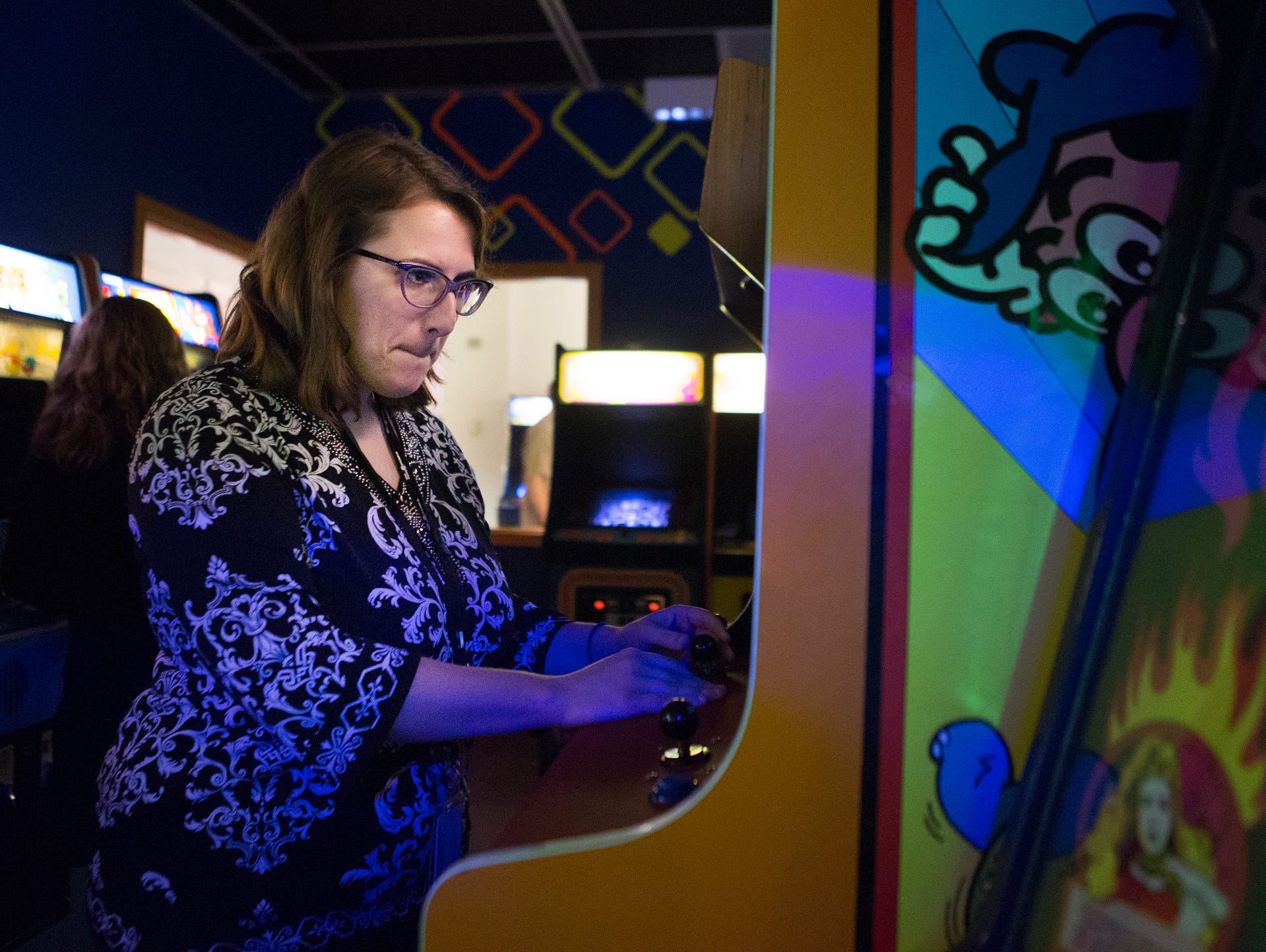
A photograph of me during my internship at The Strong. The image depicts me playing Super Mario Bros. on the day of the World Video Game Hall of Fame induction ceremony. This photograph was taken by RIT alumni Lauren Petracca, staff photographer for the Democrat & Chronicle. From the Democrat & Chronicle, June 4, 2015. Article can be found online here.