As of right now, my thesis is basically done. We've been given an extra week to work on it, but I'm debating just handing it in as it is right now so I can be done with it.
I feel like if I really wanted to I could find things to fix, but I'm also in a good enough place where I feel okay submitting it and letting it be. It's definitely not flawless, but I think when you write big papers like this you never really feel done writing it. You can have it done, but still feel like there's just one tiny thing that if you fixed, it would all be so much better. Realistically though, me holding onto this paper for another week just means that I would have another week where I probably didn't look at it, and let the assignment hang over me instead.
I'm really proud of the work I put into this paper, and I feel like I learned a lot in the process of writing it. I'm excited to let it out into the world and see what happens, and to be done with my senior thesis!
Showing posts with label #3DPrinting. Show all posts
Showing posts with label #3DPrinting. Show all posts
Tuesday, April 16, 2019

Saturday, March 30, 2019
Almost done?
Last Thursday we turned in the first FULL draft of our thesis, and now that a few days have gone by I'm feeling very relieved. I know it's not completely done yet since the paper still needs to be revised and a couple of things needed to be added, but it feels very final now that the deadline has passed. In a way though, I also feel weird not having this paper hanging over my head now. I've gotten used to thesis being part of my life since August, but now that the paper is written it's not anymore. It's a nice feeling, but I also feel like I have a lot of free time now and nothing much to do.
My plan for the next few weeks is to finish my poster draft, and then go back in probably a week and start revisions on my draft. My mom has this writing advice that if you can, you should let a paper sit for a few days so you can "mentally divorce" yourself from it, and be more critical when you go to edit. The final final draft is due in a month, so I think taking a week or two to not think about it and then going back would be really good for the revision process. Overall though, I'm relieved that it's done, and proud of myself for getting it done.
My plan for the next few weeks is to finish my poster draft, and then go back in probably a week and start revisions on my draft. My mom has this writing advice that if you can, you should let a paper sit for a few days so you can "mentally divorce" yourself from it, and be more critical when you go to edit. The final final draft is due in a month, so I think taking a week or two to not think about it and then going back would be really good for the revision process. Overall though, I'm relieved that it's done, and proud of myself for getting it done.
Monday, March 18, 2019
Back to Business
Coming back from Spring Break, things seem a lot more real now. This whole semester it's seemed like actually having the thesis "done" was a far off concept that we wouldn't get to anytime soon. Now, we have our first full draft due in ten days, the pressure is setting in.
Luckily I don't have too much more to write, since I've been writing about the process of working on my project as I was completing it. Mostly, I just need to write about my findings, and then wrap things up.
The one thing I am excited for is to piece everything together. I've been writing in stages, and keeping the different parts of my thesis in different documents. For the first full draft due next week, however, I get to put all those pieces together. I've been holding out on doing it sooner as a sort of gift for myself, since I like the finality of being able to see everything together. I'm excited about getting to see how my thesis looks when it's all put together, and to see how far I've come with it.
Luckily I don't have too much more to write, since I've been writing about the process of working on my project as I was completing it. Mostly, I just need to write about my findings, and then wrap things up.
The one thing I am excited for is to piece everything together. I've been writing in stages, and keeping the different parts of my thesis in different documents. For the first full draft due next week, however, I get to put all those pieces together. I've been holding out on doing it sooner as a sort of gift for myself, since I like the finality of being able to see everything together. I'm excited about getting to see how my thesis looks when it's all put together, and to see how far I've come with it.
Saturday, February 23, 2019
Visitor Studies Completed!
Since the last blog post update, I have not only been able to create a final print of my visors, but have also conducted three days worth of visitor observations! After printing my first version of the visor, I made adjustments to the shape of the nose hole and the size, but my second ended up being a little too small. I ended up reprinting it for a third time using brown filament, and this time the size was almost perfect. I sanded and then airbrush painted this version of the visor, which made it look more like the original and also changed the texture to feel less like a 3D print.
The next part of my project was to actually conduct the visitor survey. I went to the RMSC on Monday 2/18, Friday 2/22, and Saturday 2/23, and was able to collect a total of 71 survey responses. I also tracked on paper how many children and adults stopped to look at the setup, handled the visor, and tried it on. These numbers aren't as exact and don't say anything about the desire of the visitors, but since not all the visitors took the survey it gives me a sense of how many people interacted with the visor.
I haven't gotten to go through the data in-depth yet, but from a preliminary glance it seems that people enjoyed their experience with the visor, and found it satisfying to touch. I might go back to the RMSC to try and collect more data, but I have to talk to my advisers and see if 71 responses is enough. I'm excited to go through the data more and see what conclusions I can draw, and to keep working on my project!
The next part of my project was to actually conduct the visitor survey. I went to the RMSC on Monday 2/18, Friday 2/22, and Saturday 2/23, and was able to collect a total of 71 survey responses. I also tracked on paper how many children and adults stopped to look at the setup, handled the visor, and tried it on. These numbers aren't as exact and don't say anything about the desire of the visitors, but since not all the visitors took the survey it gives me a sense of how many people interacted with the visor.
I haven't gotten to go through the data in-depth yet, but from a preliminary glance it seems that people enjoyed their experience with the visor, and found it satisfying to touch. I might go back to the RMSC to try and collect more data, but I have to talk to my advisers and see if 71 responses is enough. I'm excited to go through the data more and see what conclusions I can draw, and to keep working on my project!
Monday, February 11, 2019
Project continuation
The last few weeks for me have been more about progressing on my project rather than writing. Two weeks ago, I was able to complete the first test print of my visor, which was good for a first try but had some serious flaws. It was way too big, and the nose hole was nowhere near the shape of a nose. Last week I worked with my friend to fix the model, and I reprinted it this weekend. It looks way better but now it's a little too small, so I'll probably do one final print later this week, and then use that model for my study.
I'm planning on going to the RMSC for visitor observations next Monday, Saturday, and Sunday. Hopefully this will give me enough data to use for my study, so this week is full of preparations to go next week. If it's not enough, I'll add additional days, but I'm starting with three and seeing what happens. To prepare for my study, I'm writing label text, gathering my supplies, creating a sign to attract visitors to the galleries, and communicating with RMSC to make everything is all set.
However, I have been working a little bit on writing. Mainly, I've been editing based on the (very helpful!) feedback I got on my first eight pages. I'm also planning on writing my next eight later this week, but I'm a little worried about running out of things to write. The next big bulk of writing I have to do is about my study, and since I haven't completed it yet I don't want to write a bunch of fluff and then fill in information later. So for now I'm focused on my visitor observations next week. Fingers crossed that it goes well!
I'm planning on going to the RMSC for visitor observations next Monday, Saturday, and Sunday. Hopefully this will give me enough data to use for my study, so this week is full of preparations to go next week. If it's not enough, I'll add additional days, but I'm starting with three and seeing what happens. To prepare for my study, I'm writing label text, gathering my supplies, creating a sign to attract visitors to the galleries, and communicating with RMSC to make everything is all set.
However, I have been working a little bit on writing. Mainly, I've been editing based on the (very helpful!) feedback I got on my first eight pages. I'm also planning on writing my next eight later this week, but I'm a little worried about running out of things to write. The next big bulk of writing I have to do is about my study, and since I haven't completed it yet I don't want to write a bunch of fluff and then fill in information later. So for now I'm focused on my visitor observations next week. Fingers crossed that it goes well!
Tuesday, December 4, 2018
Plans for Winter Break
With finals so close, it's a little hard to think beyond them to Winter Break. Right now though, I'm planning to get two big things done over break: developing my Visitor Engagement study, and creating a complete Mesh Model of my object.
For the first of these, the study, I'm hoping over break to develop the study, determine what data I will be collecting, and how I will be collecting it. I have some ideas right now about how I would like this survey to work, but I'm going to devote time over break to deciding what collection method I will use. For example, will there be a written survey for visitors or just observations by me? I also want to decide how much data I want to collect.
For the second part, creating the Mesh Model, I am going to work with modeling software to inspect the scan of my object and fix any errors, so I can have a complete working model when I return in the spring. I met with the Rochester Museum and Science Center earlier today and selected an object to use for my thesis project (yay!), and I hopefully will be scanning it next week. This means I will have a month to learn the modeling software, and to work with it to complete my model.
To accomplish both of these goals, I am planning on allocating 2-3 hours every week (tentatively) to work on my thesis. I think this is a reasonable about of time in which I can complete these tasks, and I'm looking forward to returning in the spring to continue with my project!
For the first of these, the study, I'm hoping over break to develop the study, determine what data I will be collecting, and how I will be collecting it. I have some ideas right now about how I would like this survey to work, but I'm going to devote time over break to deciding what collection method I will use. For example, will there be a written survey for visitors or just observations by me? I also want to decide how much data I want to collect.
For the second part, creating the Mesh Model, I am going to work with modeling software to inspect the scan of my object and fix any errors, so I can have a complete working model when I return in the spring. I met with the Rochester Museum and Science Center earlier today and selected an object to use for my thesis project (yay!), and I hopefully will be scanning it next week. This means I will have a month to learn the modeling software, and to work with it to complete my model.
To accomplish both of these goals, I am planning on allocating 2-3 hours every week (tentatively) to work on my thesis. I think this is a reasonable about of time in which I can complete these tasks, and I'm looking forward to returning in the spring to continue with my project!
 |
| One of the methods I'm considering using for my Visitor Engagement study is an online form, such as a Google Form. Image Source: University of Minnesota |
Monday, November 26, 2018
From Concept to Project
Over the past semester, my thesis project has taken new forms, and developed in ways I didn't expect. When I first brainstormed my idea it was nothing more than "3D printed reproductions and touch," and I've done a lot of adjusting to that core idea over time. The first main issue I faced was to determine what exactly it was I wanted to find out. Are 3D reproductions sufficient stand-ins for a real object? Do visitors want to touch objects? Will the fake object enhance their experience? After a lot of thinking, research, and discussion with my advisers, I settled on exploring the topic of whether or not 3D reproductions fulfill the desire of a visitor to touch museum objects.
I also changed the scope of my project over the course of the semester. I initially imagined setting up my display case somewhere on campus, but am now working with the Rochester Museum and Science Center to select and scan an object from their collections, and put it on display at their institution. I think this will provide me with better data, and will give me a wider variety of objects to choose from.
Additionally, my desire to create an accurate facsimile has led me to consider methods other than 3D printing to create the reproduction of my selected object. My choice of reproduction method will depend largely on what object I chose, which is also the next step for my project. I'm looking forward to moving forward with my project, and seeing where it continues to develop!
I also changed the scope of my project over the course of the semester. I initially imagined setting up my display case somewhere on campus, but am now working with the Rochester Museum and Science Center to select and scan an object from their collections, and put it on display at their institution. I think this will provide me with better data, and will give me a wider variety of objects to choose from.
Additionally, my desire to create an accurate facsimile has led me to consider methods other than 3D printing to create the reproduction of my selected object. My choice of reproduction method will depend largely on what object I chose, which is also the next step for my project. I'm looking forward to moving forward with my project, and seeing where it continues to develop!
 |
| Depending on what object I select, I might end up using something such as a CNC Milling machine to create my facsimile rather than a 3D printer. This machine removes wood to create an object, whereas a printer adds material to create. Image source |
Tuesday, November 6, 2018
Learning about my topic
As I conduct research for my thesis, I'm struck by how rather than focusing on one specific topic, my project seems to be overlapping several broad topics. This has caused me to break down my sources into four main categories: touch, facsimile, 3D printing/process, and visitor engagement. All of these topics are crucial to completing my project to the extent that I wish to, and each are giving me important insight into my project. 3D printing/process are helping me to understand what exactly it is I need to do in order to scan and print a successful 3D model of an object, while touch is making me consider why people might want to touch a museum object, and whether a facsimile seems to fulfill those needs. Facsimile is giving me historic insight into the role of object reproductions in museums and the reception they tend to receive, and visitor engagement is making me think about how I can best study if facsimiles fulfill the desire of a visitor to touch the objects. All of this knowledge is important for me to complete my thesis, but the different topics have made it a bit difficult to gather and sort through my sources.
For my thesis, I still need to know a little bit more about how I can best conduct a visitor engagement study. I keep on weighing different methods of collecting visitor feedback, as well as how I can quantitatively measure the impact my object has on their desire to touch. However, I'm not sure if this decision can be made through just research alone, or if I need to talk with other people about their thoughts as well.
For my thesis, I still need to know a little bit more about how I can best conduct a visitor engagement study. I keep on weighing different methods of collecting visitor feedback, as well as how I can quantitatively measure the impact my object has on their desire to touch. However, I'm not sure if this decision can be made through just research alone, or if I need to talk with other people about their thoughts as well.
 |
| I've found it helpful to physically group my sources into their categories. It helps me keep track of how many sources I have for each, and what the different literature on a specific topic is. |
Tuesday, October 2, 2018
My (working) Research Question
Human beings have a desire to touch things. To hold an object can allow us to gather more information about it using our senses, and give us a greater appreciation for it. As museum professionals however, we know that oftentimes, museums aren't sites that can easily facilitate this desire. Most of the time, museum objects aren't allowed to be touched due to their rarity, fragility, or other factors that require limited human contact with them. There are of course exceptions, such as teaching collections and interactives that incorporate the object, but for the most part, museums are "no touch zones." How can we as museum professionals, create solutions to fulfill the human desire to touch? Does this desire interfere with the museum experience, or is the public acclimated to the environment of museums enough that it doesn't affect their experience? For my thesis project, I would like to examine these ideas through the use of facsimiles, mainly those that are 3D printed or created through other relatively cheap and easy methods.
The ultimate goal of my thesis project is to answer the question: "Can facsimiles of museum objects help fulfill the desire of visitors to touch items on display?" In order to answer this question, I will be conducting a two-part project. In the first part, a selected object will be reproduced using 3D printing or another method available at RIT. The AMPrint Center has some interesting ways of creating objects, and depending on what I chose to reproduce, a method other than 3D printing might be best. The goal of this phase is to create a facsimile that mirrors the original object as closely as possible, from its size, to its weight, to any textures the object might have. This might not be possible given the available technology, but ideally, I would like for the reproduction to be as similar as possible to the original in order to effectively serve as a surrogate for it.
In the second phase of my project, the reproduced object will be placed on display in a local institution, alongside the original object. Visitors will be encouraged to interact with the reproduction, and a visitor study survey will be conducted into how, if at all, interacting with the object enhanced their museum experience. Did they have an initial desire to touch the original object? Did the facsimile help to fulfill that desire? Did it make the desire to hold the original object stronger?
Time permitting, I would like to do this project twice; once at an institution that tends to encourage interactivity for the visitors (such as the RMSC), and once at an institution that usually doesn't allow visitors to interact in the galleries (such as the MAG). I think this could uncover some really interesting information about what a visitor expects out of a museum visit, and how museum professionals can work to meet those expectations.
The ultimate goal of my thesis project is to answer the question: "Can facsimiles of museum objects help fulfill the desire of visitors to touch items on display?" In order to answer this question, I will be conducting a two-part project. In the first part, a selected object will be reproduced using 3D printing or another method available at RIT. The AMPrint Center has some interesting ways of creating objects, and depending on what I chose to reproduce, a method other than 3D printing might be best. The goal of this phase is to create a facsimile that mirrors the original object as closely as possible, from its size, to its weight, to any textures the object might have. This might not be possible given the available technology, but ideally, I would like for the reproduction to be as similar as possible to the original in order to effectively serve as a surrogate for it.
In the second phase of my project, the reproduced object will be placed on display in a local institution, alongside the original object. Visitors will be encouraged to interact with the reproduction, and a visitor study survey will be conducted into how, if at all, interacting with the object enhanced their museum experience. Did they have an initial desire to touch the original object? Did the facsimile help to fulfill that desire? Did it make the desire to hold the original object stronger?
Time permitting, I would like to do this project twice; once at an institution that tends to encourage interactivity for the visitors (such as the RMSC), and once at an institution that usually doesn't allow visitors to interact in the galleries (such as the MAG). I think this could uncover some really interesting information about what a visitor expects out of a museum visit, and how museum professionals can work to meet those expectations.
 |
| From Beth Compton: "Replicas of an ulu artifact (Ikaahuk Archaeology Project). From left to right: white 3D print, colour 3D print, handmade replica (by Tim Rast), and the original artifact excavated from Banks Island, NWT. Photograph by Beth Compton." Click here for source |
Thursday, September 27, 2018
Articles on 3D Printing in Museums
Mostly, what I learned from the close reading of my two articles is that my topic isn't one that's been explored very much. Neither of the articles I read, "Flip-flopping museum objects from physical to digital - and back again" and "3D printing and 3D scanning of our ancient history" related exactly to what I want to research for my thesis project. The first article discussed a case study in which visitors were allowed to scan, remix, and then 3D print sculptures at an art museum in Denmark, while the second was about the importance of having 3D facsimiles and scans of Iraqi artifacts available so that the people of Iraq can understand their cultural heritage. The articles didn't give me a ton of information on my topic, but both provided insight into how academic articles should be written.
The first article I read ("Flip-flopping museum objects from physical to digital - and back again") was laid out very clearly, with each section defined, and all potentially unknown concepts explained for the reader. This is the type of article I would like to emulate with my own thesis; something that's clear and understandable for the reader. The second article I read however, was not particularly clear. There was little evidence to back up the author's points, and most of the article was devoted to discussing important Iraqi achievements, which was interesting, but not related to how 3D printing can help preserve cultural heritage. These two articles therefore gave me more insight into the format and shape I want my thesis to take rather than the content itself, but I still feel it was valuable.
Both articles also provided interesting information about the research methods employed. For the first article, the author detailed how she spent eight weeks observing visitors to the museum who interacted with the 3D remixing and printing of sculptures. She discussed observing them, in some cases interviewing them, and how this provided insight into the visitor experience. This also felt important to me, as I'm hoping to complete a visitor experience study as part of my thesis. The second article meanwhile, didn't provide much insight into the research methods employed. The authors cited some books and journals, but that was all they detailed about their research methods. This made it hard to gain insight, since I'm not entirely certain what methods they used to do research for this article.
Overall, I found these articles to be interesting, even though they didn't necessarily relate to my topic. One thing that was really helpful however, was looking at their citations. Both articles cited sources that I think might be beneficial for me to look at, as they seem to relate more to my topic. These articles gave me helpful insight into what research methods I can employ for my own project, and I'm excited to continue researching and working to develop my thesis idea.
Sources:
Article 1: Lisa Skytte Jakobsen, "Flip-flopping museum objects from physical to digital - and back again," Nordisk Museologi 2016, 1 (2016): 121-137
Article 2: Al-Baghdadi, Maher A. R. Sadiq, "3D printing and 3D scanning of our ancient history: Preservation and protection of our cultural heritage and identity," International Journal of Energy and Environment 8, 5 (2017): 441-456
The first article I read ("Flip-flopping museum objects from physical to digital - and back again") was laid out very clearly, with each section defined, and all potentially unknown concepts explained for the reader. This is the type of article I would like to emulate with my own thesis; something that's clear and understandable for the reader. The second article I read however, was not particularly clear. There was little evidence to back up the author's points, and most of the article was devoted to discussing important Iraqi achievements, which was interesting, but not related to how 3D printing can help preserve cultural heritage. These two articles therefore gave me more insight into the format and shape I want my thesis to take rather than the content itself, but I still feel it was valuable.
Both articles also provided interesting information about the research methods employed. For the first article, the author detailed how she spent eight weeks observing visitors to the museum who interacted with the 3D remixing and printing of sculptures. She discussed observing them, in some cases interviewing them, and how this provided insight into the visitor experience. This also felt important to me, as I'm hoping to complete a visitor experience study as part of my thesis. The second article meanwhile, didn't provide much insight into the research methods employed. The authors cited some books and journals, but that was all they detailed about their research methods. This made it hard to gain insight, since I'm not entirely certain what methods they used to do research for this article.
Overall, I found these articles to be interesting, even though they didn't necessarily relate to my topic. One thing that was really helpful however, was looking at their citations. Both articles cited sources that I think might be beneficial for me to look at, as they seem to relate more to my topic. These articles gave me helpful insight into what research methods I can employ for my own project, and I'm excited to continue researching and working to develop my thesis idea.
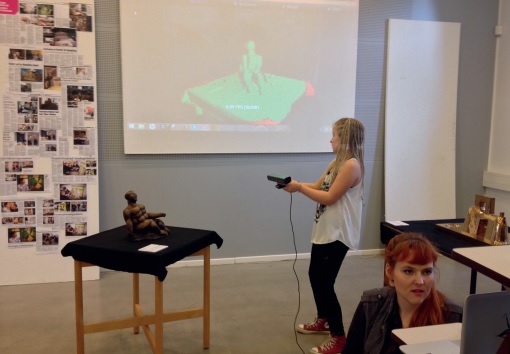 |
| A photo included in the first article of a visitor 3D scanning one of the museum's sculptures. Photo by Lise Skytte Jakobsen (article author). From Flip-flopping museum objects from physical to digital - and back again |
Article 1: Lisa Skytte Jakobsen, "Flip-flopping museum objects from physical to digital - and back again," Nordisk Museologi 2016, 1 (2016): 121-137
Article 2: Al-Baghdadi, Maher A. R. Sadiq, "3D printing and 3D scanning of our ancient history: Preservation and protection of our cultural heritage and identity," International Journal of Energy and Environment 8, 5 (2017): 441-456
Subscribe to:
Posts (Atom)