Hello Everyone,
Hope you all are doing well! The last couple of weeks have been super crazy and I'm still trying to get into a regular routine. My thesis is still progressing, although very slowly. I have a bit more to do and I just need to push through! I am hoping to have my rough draft finished soonish? I still have some pages to write and some edits to finish! I've been trying to think of all the information that is instrumental to its completion so that I am not adding any unnecessary fluff! My poster is also still on my list of things to do, and I will hopefully finish that piece in the next couple of weeks. Stay safe!
Showing posts with label #seniorthesis. Show all posts
Showing posts with label #seniorthesis. Show all posts
Tuesday, March 31, 2020

Saturday, March 30, 2019
Almost done?
Last Thursday we turned in the first FULL draft of our thesis, and now that a few days have gone by I'm feeling very relieved. I know it's not completely done yet since the paper still needs to be revised and a couple of things needed to be added, but it feels very final now that the deadline has passed. In a way though, I also feel weird not having this paper hanging over my head now. I've gotten used to thesis being part of my life since August, but now that the paper is written it's not anymore. It's a nice feeling, but I also feel like I have a lot of free time now and nothing much to do.
My plan for the next few weeks is to finish my poster draft, and then go back in probably a week and start revisions on my draft. My mom has this writing advice that if you can, you should let a paper sit for a few days so you can "mentally divorce" yourself from it, and be more critical when you go to edit. The final final draft is due in a month, so I think taking a week or two to not think about it and then going back would be really good for the revision process. Overall though, I'm relieved that it's done, and proud of myself for getting it done.
My plan for the next few weeks is to finish my poster draft, and then go back in probably a week and start revisions on my draft. My mom has this writing advice that if you can, you should let a paper sit for a few days so you can "mentally divorce" yourself from it, and be more critical when you go to edit. The final final draft is due in a month, so I think taking a week or two to not think about it and then going back would be really good for the revision process. Overall though, I'm relieved that it's done, and proud of myself for getting it done.
Monday, March 18, 2019
Back to Business
Coming back from Spring Break, things seem a lot more real now. This whole semester it's seemed like actually having the thesis "done" was a far off concept that we wouldn't get to anytime soon. Now, we have our first full draft due in ten days, the pressure is setting in.
Luckily I don't have too much more to write, since I've been writing about the process of working on my project as I was completing it. Mostly, I just need to write about my findings, and then wrap things up.
The one thing I am excited for is to piece everything together. I've been writing in stages, and keeping the different parts of my thesis in different documents. For the first full draft due next week, however, I get to put all those pieces together. I've been holding out on doing it sooner as a sort of gift for myself, since I like the finality of being able to see everything together. I'm excited about getting to see how my thesis looks when it's all put together, and to see how far I've come with it.
Luckily I don't have too much more to write, since I've been writing about the process of working on my project as I was completing it. Mostly, I just need to write about my findings, and then wrap things up.
The one thing I am excited for is to piece everything together. I've been writing in stages, and keeping the different parts of my thesis in different documents. For the first full draft due next week, however, I get to put all those pieces together. I've been holding out on doing it sooner as a sort of gift for myself, since I like the finality of being able to see everything together. I'm excited about getting to see how my thesis looks when it's all put together, and to see how far I've come with it.
Monday, February 11, 2019
Project continuation
The last few weeks for me have been more about progressing on my project rather than writing. Two weeks ago, I was able to complete the first test print of my visor, which was good for a first try but had some serious flaws. It was way too big, and the nose hole was nowhere near the shape of a nose. Last week I worked with my friend to fix the model, and I reprinted it this weekend. It looks way better but now it's a little too small, so I'll probably do one final print later this week, and then use that model for my study.
I'm planning on going to the RMSC for visitor observations next Monday, Saturday, and Sunday. Hopefully this will give me enough data to use for my study, so this week is full of preparations to go next week. If it's not enough, I'll add additional days, but I'm starting with three and seeing what happens. To prepare for my study, I'm writing label text, gathering my supplies, creating a sign to attract visitors to the galleries, and communicating with RMSC to make everything is all set.
However, I have been working a little bit on writing. Mainly, I've been editing based on the (very helpful!) feedback I got on my first eight pages. I'm also planning on writing my next eight later this week, but I'm a little worried about running out of things to write. The next big bulk of writing I have to do is about my study, and since I haven't completed it yet I don't want to write a bunch of fluff and then fill in information later. So for now I'm focused on my visitor observations next week. Fingers crossed that it goes well!
I'm planning on going to the RMSC for visitor observations next Monday, Saturday, and Sunday. Hopefully this will give me enough data to use for my study, so this week is full of preparations to go next week. If it's not enough, I'll add additional days, but I'm starting with three and seeing what happens. To prepare for my study, I'm writing label text, gathering my supplies, creating a sign to attract visitors to the galleries, and communicating with RMSC to make everything is all set.
However, I have been working a little bit on writing. Mainly, I've been editing based on the (very helpful!) feedback I got on my first eight pages. I'm also planning on writing my next eight later this week, but I'm a little worried about running out of things to write. The next big bulk of writing I have to do is about my study, and since I haven't completed it yet I don't want to write a bunch of fluff and then fill in information later. So for now I'm focused on my visitor observations next week. Fingers crossed that it goes well!
Saturday, January 26, 2019
Spring Semester Begins
I can't believe we're already approaching week 3! With school back in full swing, I've been doing a lot of research on the preservation of the Scottish Gaelic language and trying to uncover case studies in which cultural institutions in Scotland contribute to the language's preservation and revitalization. As I've mentioned, I decided to focus on Scottish Gaelic for my research, rather than doing all three (Scottish Gaelic, Irish, and Welsh). The reasoning behind this is to focus my research and delve in deep without overwhelming myself, especially given the thesis deadlines and how fast the semester will go by. I spent my winter break gathering preliminary sources on Scottish Gaelic, and now I'm working on reading through them and refining my searches.
As I look ahead, I believe my challenge will be trying to define success in order to propose suggestions for how museums can preserve and revitalize endangered languages. Because this seems to be a relatively new area of study (the intersection of cultural institutions and endangered languages), the possibilities are exciting, but it also makes it difficult to evaluate shortcomings and successes. For example, there are language policies that have been enacted within the past couple years. But, if success were to be hypothetically based on number of speakers, you'd have to wait for the next generation to grow up to see if they're passing on the language to their children and compare that to the number of speakers before the language policies were put in place. Or, I could base success on something more in the moment, like visitor engagement in cultural institutions with bilingual signage, for example.
I'm keeping all of this in the back of my mind as I research. I'm hoping that the more I read and find case studies the clearer this will become. I am also considering reaching out to museums to inquire about more information on Scottish Gaelic from their viewpoints of actually interacting with the public in Scotland.
As I look ahead, I believe my challenge will be trying to define success in order to propose suggestions for how museums can preserve and revitalize endangered languages. Because this seems to be a relatively new area of study (the intersection of cultural institutions and endangered languages), the possibilities are exciting, but it also makes it difficult to evaluate shortcomings and successes. For example, there are language policies that have been enacted within the past couple years. But, if success were to be hypothetically based on number of speakers, you'd have to wait for the next generation to grow up to see if they're passing on the language to their children and compare that to the number of speakers before the language policies were put in place. Or, I could base success on something more in the moment, like visitor engagement in cultural institutions with bilingual signage, for example.
I'm keeping all of this in the back of my mind as I research. I'm hoping that the more I read and find case studies the clearer this will become. I am also considering reaching out to museums to inquire about more information on Scottish Gaelic from their viewpoints of actually interacting with the public in Scotland.
Tuesday, December 4, 2018
Plans for Winter Break
With finals so close, it's a little hard to think beyond them to Winter Break. Right now though, I'm planning to get two big things done over break: developing my Visitor Engagement study, and creating a complete Mesh Model of my object.
For the first of these, the study, I'm hoping over break to develop the study, determine what data I will be collecting, and how I will be collecting it. I have some ideas right now about how I would like this survey to work, but I'm going to devote time over break to deciding what collection method I will use. For example, will there be a written survey for visitors or just observations by me? I also want to decide how much data I want to collect.
For the second part, creating the Mesh Model, I am going to work with modeling software to inspect the scan of my object and fix any errors, so I can have a complete working model when I return in the spring. I met with the Rochester Museum and Science Center earlier today and selected an object to use for my thesis project (yay!), and I hopefully will be scanning it next week. This means I will have a month to learn the modeling software, and to work with it to complete my model.
To accomplish both of these goals, I am planning on allocating 2-3 hours every week (tentatively) to work on my thesis. I think this is a reasonable about of time in which I can complete these tasks, and I'm looking forward to returning in the spring to continue with my project!
For the first of these, the study, I'm hoping over break to develop the study, determine what data I will be collecting, and how I will be collecting it. I have some ideas right now about how I would like this survey to work, but I'm going to devote time over break to deciding what collection method I will use. For example, will there be a written survey for visitors or just observations by me? I also want to decide how much data I want to collect.
For the second part, creating the Mesh Model, I am going to work with modeling software to inspect the scan of my object and fix any errors, so I can have a complete working model when I return in the spring. I met with the Rochester Museum and Science Center earlier today and selected an object to use for my thesis project (yay!), and I hopefully will be scanning it next week. This means I will have a month to learn the modeling software, and to work with it to complete my model.
To accomplish both of these goals, I am planning on allocating 2-3 hours every week (tentatively) to work on my thesis. I think this is a reasonable about of time in which I can complete these tasks, and I'm looking forward to returning in the spring to continue with my project!
 |
| One of the methods I'm considering using for my Visitor Engagement study is an online form, such as a Google Form. Image Source: University of Minnesota |
Blog Post VII: Winter Break Plans
I plan on taking full advantage of the break and first giving myself some time to rest and relax. Allowing myself some time away from my thesis will be beneficial I think because I can then return to it with fresh eyes and ideas. After the holiday, during the second half of the break, I plan on doing some more reading and seeing if I can ascertain whether I need to focus on one language for my case study (Scottish Gaelic, Irish, or Welsh) or if it’s feasible to do all three. If I can figure this out, or at least begin to, over break by looking at some initial resources then I can jump right in during spring semester. And of course I’ll be working on my literature review after receiving feedback from my advisers so that I can get in the revised version for them to sign.
Overall, I’m just really looking forward to going home and seeing my family (and my dog!). It’ll be nice to be able to just focus on thesis without the assignments/projects/tests of other classes. I will be able to allocate more time to my research in this way and also get some new perspectives from my family who will be curious about my thesis.
I can’t believe we’re halfway through our senior year!
 |
| Here's a cute picture of my dog to help ease the stress of these last few days of the semester! |
Monday, November 26, 2018
Blog Post VI: From Conceptualization to Fruition
The main topic of my thesis has remained the same, but throughout the past few weeks, I’ve gained more clarity on how to approach my research project. At the beginning, I knew I wanted to focus on endangered languages in the United Kingdom and Ireland for the case studies of the main body of my thesis. Therefore, I wasn’t quite sure what case studies or examples to discuss in my literature review without being redundant. I decided to just do some general research on language preservation and revitalization as a general subject/area of study. Ultimately, this ended up being a successful strategy because I found some great core readings on the subject which helped shape my lit review. A couple of my sources were written by linguist Leanne Hinton, who mentioned a few workshops here in the U.S. involving Native American tribes and museum institutions, which I discuss in Blog Post V. I had heard of these before in my own personal research during the past year, so I thought it would be great to discuss them as examples of current museums efforts in the U.S. which will set up a nice segway into a discussion comparing and contrasting them to my case studies in the U.K. Furthermore, I’ve been inspired by one of my linguistics classes, Evolving English Language, to include a section about the spread of English and how it affects other languages. Overall, not overthinking or narrowing my initial research and keeping my mind open have really helped my process.
I can see my thesis evolving quite a bit as I uncover how much information there is about Celtic languages (Scottish Gaelic, Irish, Welsh). If there ends up being a lot of information to work with (concerning policy, community programs, museum efforts) I may end up just focusing on one of the languages and delving in deep. If there is not a significant amount of information, I will have to figure out how to best survey language preservation and revitalization efforts. However it ends up, I’m excited to see how cultural institutions can help and hopefully present some novel ideas and methods to both fields (museums/linguistics).
 |
| This is a diagram I found after searching in Google "Celtic Languages." The map, from the Brilliant Maps site, is helpful to situate oneself as to where the languages in my case studies are mainly located. It also includes some statistics, although they are not cited. |
Saturday, November 10, 2018
Progress Report
Hello everyone! As some of you may recall, my thesis questions are: Why build a sports museum in Buffalo, New York? How will a museum add to the city of Buffalo’s revitalization project? I wanted to provide a brief recap of my senior thesis topic and the progression of my research process. I began my research by studying the history of Buffalo, New York. Then I dove into reading materials that reminisced about various sports teams that developed in Buffalo over the years. Lastly, I will look at studies that were conducted on the topic of regional identity through sports.
So far I have learned that Buffalo was a mega-industrial city in its prime, due to its natural harbor, the power source of Niagara Falls, and the construction of the Eire Canal. The features previously mentioned turned Buffalo into a major merchant/transportation hub, because of its role in international trade with Canada and connection to the mid-west. Industries flourished under these conditions such as Lackawanna Steel, Larkin Soap company, George N. Pierce’s automobile company, and several flours, cereal, and beer companies throughout the city. While reading a book called The Golden Age of Buffalo Sports, I found out that Jackie Robinson played in Buffalo frequently and people were quite excited to see him play. Also, Buffalo’s baseball team, the Bisons, had two uniquely deaf players. I have just begun to read about the case studies that were conducted on sports fans, stay tuned for updates.
What I still need to research on, is the sports teams, the Sabers, the Bandits, Braves, and the FC Buffalo. I want to conduct a survey where Buffalo Sports fans answer questions pertaining to a possible creation of a Buffalo Sports Museum. The survey will be a collection of 5 questions available on both paper and online. I plan on attending the Bills and Sabers tailgate parties that happen before home games. Then I can add this survey to my research paper!
Tuesday, November 6, 2018
Learning about my topic
As I conduct research for my thesis, I'm struck by how rather than focusing on one specific topic, my project seems to be overlapping several broad topics. This has caused me to break down my sources into four main categories: touch, facsimile, 3D printing/process, and visitor engagement. All of these topics are crucial to completing my project to the extent that I wish to, and each are giving me important insight into my project. 3D printing/process are helping me to understand what exactly it is I need to do in order to scan and print a successful 3D model of an object, while touch is making me consider why people might want to touch a museum object, and whether a facsimile seems to fulfill those needs. Facsimile is giving me historic insight into the role of object reproductions in museums and the reception they tend to receive, and visitor engagement is making me think about how I can best study if facsimiles fulfill the desire of a visitor to touch the objects. All of this knowledge is important for me to complete my thesis, but the different topics have made it a bit difficult to gather and sort through my sources.
For my thesis, I still need to know a little bit more about how I can best conduct a visitor engagement study. I keep on weighing different methods of collecting visitor feedback, as well as how I can quantitatively measure the impact my object has on their desire to touch. However, I'm not sure if this decision can be made through just research alone, or if I need to talk with other people about their thoughts as well.
For my thesis, I still need to know a little bit more about how I can best conduct a visitor engagement study. I keep on weighing different methods of collecting visitor feedback, as well as how I can quantitatively measure the impact my object has on their desire to touch. However, I'm not sure if this decision can be made through just research alone, or if I need to talk with other people about their thoughts as well.
 |
| I've found it helpful to physically group my sources into their categories. It helps me keep track of how many sources I have for each, and what the different literature on a specific topic is. |
Tuesday, October 2, 2018
My (working) Research Question
Human beings have a desire to touch things. To hold an object can allow us to gather more information about it using our senses, and give us a greater appreciation for it. As museum professionals however, we know that oftentimes, museums aren't sites that can easily facilitate this desire. Most of the time, museum objects aren't allowed to be touched due to their rarity, fragility, or other factors that require limited human contact with them. There are of course exceptions, such as teaching collections and interactives that incorporate the object, but for the most part, museums are "no touch zones." How can we as museum professionals, create solutions to fulfill the human desire to touch? Does this desire interfere with the museum experience, or is the public acclimated to the environment of museums enough that it doesn't affect their experience? For my thesis project, I would like to examine these ideas through the use of facsimiles, mainly those that are 3D printed or created through other relatively cheap and easy methods.
The ultimate goal of my thesis project is to answer the question: "Can facsimiles of museum objects help fulfill the desire of visitors to touch items on display?" In order to answer this question, I will be conducting a two-part project. In the first part, a selected object will be reproduced using 3D printing or another method available at RIT. The AMPrint Center has some interesting ways of creating objects, and depending on what I chose to reproduce, a method other than 3D printing might be best. The goal of this phase is to create a facsimile that mirrors the original object as closely as possible, from its size, to its weight, to any textures the object might have. This might not be possible given the available technology, but ideally, I would like for the reproduction to be as similar as possible to the original in order to effectively serve as a surrogate for it.
In the second phase of my project, the reproduced object will be placed on display in a local institution, alongside the original object. Visitors will be encouraged to interact with the reproduction, and a visitor study survey will be conducted into how, if at all, interacting with the object enhanced their museum experience. Did they have an initial desire to touch the original object? Did the facsimile help to fulfill that desire? Did it make the desire to hold the original object stronger?
Time permitting, I would like to do this project twice; once at an institution that tends to encourage interactivity for the visitors (such as the RMSC), and once at an institution that usually doesn't allow visitors to interact in the galleries (such as the MAG). I think this could uncover some really interesting information about what a visitor expects out of a museum visit, and how museum professionals can work to meet those expectations.
The ultimate goal of my thesis project is to answer the question: "Can facsimiles of museum objects help fulfill the desire of visitors to touch items on display?" In order to answer this question, I will be conducting a two-part project. In the first part, a selected object will be reproduced using 3D printing or another method available at RIT. The AMPrint Center has some interesting ways of creating objects, and depending on what I chose to reproduce, a method other than 3D printing might be best. The goal of this phase is to create a facsimile that mirrors the original object as closely as possible, from its size, to its weight, to any textures the object might have. This might not be possible given the available technology, but ideally, I would like for the reproduction to be as similar as possible to the original in order to effectively serve as a surrogate for it.
In the second phase of my project, the reproduced object will be placed on display in a local institution, alongside the original object. Visitors will be encouraged to interact with the reproduction, and a visitor study survey will be conducted into how, if at all, interacting with the object enhanced their museum experience. Did they have an initial desire to touch the original object? Did the facsimile help to fulfill that desire? Did it make the desire to hold the original object stronger?
Time permitting, I would like to do this project twice; once at an institution that tends to encourage interactivity for the visitors (such as the RMSC), and once at an institution that usually doesn't allow visitors to interact in the galleries (such as the MAG). I think this could uncover some really interesting information about what a visitor expects out of a museum visit, and how museum professionals can work to meet those expectations.
 |
| From Beth Compton: "Replicas of an ulu artifact (Ikaahuk Archaeology Project). From left to right: white 3D print, colour 3D print, handmade replica (by Tim Rast), and the original artifact excavated from Banks Island, NWT. Photograph by Beth Compton." Click here for source |
Thursday, September 27, 2018
Articles on 3D Printing in Museums
Mostly, what I learned from the close reading of my two articles is that my topic isn't one that's been explored very much. Neither of the articles I read, "Flip-flopping museum objects from physical to digital - and back again" and "3D printing and 3D scanning of our ancient history" related exactly to what I want to research for my thesis project. The first article discussed a case study in which visitors were allowed to scan, remix, and then 3D print sculptures at an art museum in Denmark, while the second was about the importance of having 3D facsimiles and scans of Iraqi artifacts available so that the people of Iraq can understand their cultural heritage. The articles didn't give me a ton of information on my topic, but both provided insight into how academic articles should be written.
The first article I read ("Flip-flopping museum objects from physical to digital - and back again") was laid out very clearly, with each section defined, and all potentially unknown concepts explained for the reader. This is the type of article I would like to emulate with my own thesis; something that's clear and understandable for the reader. The second article I read however, was not particularly clear. There was little evidence to back up the author's points, and most of the article was devoted to discussing important Iraqi achievements, which was interesting, but not related to how 3D printing can help preserve cultural heritage. These two articles therefore gave me more insight into the format and shape I want my thesis to take rather than the content itself, but I still feel it was valuable.
Both articles also provided interesting information about the research methods employed. For the first article, the author detailed how she spent eight weeks observing visitors to the museum who interacted with the 3D remixing and printing of sculptures. She discussed observing them, in some cases interviewing them, and how this provided insight into the visitor experience. This also felt important to me, as I'm hoping to complete a visitor experience study as part of my thesis. The second article meanwhile, didn't provide much insight into the research methods employed. The authors cited some books and journals, but that was all they detailed about their research methods. This made it hard to gain insight, since I'm not entirely certain what methods they used to do research for this article.
Overall, I found these articles to be interesting, even though they didn't necessarily relate to my topic. One thing that was really helpful however, was looking at their citations. Both articles cited sources that I think might be beneficial for me to look at, as they seem to relate more to my topic. These articles gave me helpful insight into what research methods I can employ for my own project, and I'm excited to continue researching and working to develop my thesis idea.
Sources:
Article 1: Lisa Skytte Jakobsen, "Flip-flopping museum objects from physical to digital - and back again," Nordisk Museologi 2016, 1 (2016): 121-137
Article 2: Al-Baghdadi, Maher A. R. Sadiq, "3D printing and 3D scanning of our ancient history: Preservation and protection of our cultural heritage and identity," International Journal of Energy and Environment 8, 5 (2017): 441-456
The first article I read ("Flip-flopping museum objects from physical to digital - and back again") was laid out very clearly, with each section defined, and all potentially unknown concepts explained for the reader. This is the type of article I would like to emulate with my own thesis; something that's clear and understandable for the reader. The second article I read however, was not particularly clear. There was little evidence to back up the author's points, and most of the article was devoted to discussing important Iraqi achievements, which was interesting, but not related to how 3D printing can help preserve cultural heritage. These two articles therefore gave me more insight into the format and shape I want my thesis to take rather than the content itself, but I still feel it was valuable.
Both articles also provided interesting information about the research methods employed. For the first article, the author detailed how she spent eight weeks observing visitors to the museum who interacted with the 3D remixing and printing of sculptures. She discussed observing them, in some cases interviewing them, and how this provided insight into the visitor experience. This also felt important to me, as I'm hoping to complete a visitor experience study as part of my thesis. The second article meanwhile, didn't provide much insight into the research methods employed. The authors cited some books and journals, but that was all they detailed about their research methods. This made it hard to gain insight, since I'm not entirely certain what methods they used to do research for this article.
Overall, I found these articles to be interesting, even though they didn't necessarily relate to my topic. One thing that was really helpful however, was looking at their citations. Both articles cited sources that I think might be beneficial for me to look at, as they seem to relate more to my topic. These articles gave me helpful insight into what research methods I can employ for my own project, and I'm excited to continue researching and working to develop my thesis idea.
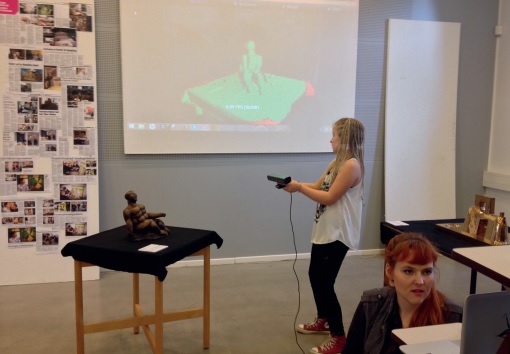 |
| A photo included in the first article of a visitor 3D scanning one of the museum's sculptures. Photo by Lise Skytte Jakobsen (article author). From Flip-flopping museum objects from physical to digital - and back again |
Article 1: Lisa Skytte Jakobsen, "Flip-flopping museum objects from physical to digital - and back again," Nordisk Museologi 2016, 1 (2016): 121-137
Article 2: Al-Baghdadi, Maher A. R. Sadiq, "3D printing and 3D scanning of our ancient history: Preservation and protection of our cultural heritage and identity," International Journal of Energy and Environment 8, 5 (2017): 441-456
Thursday, May 3, 2018
Wow, it's done, hurrah...
Requisite "Wow, it's done, hurrah" aside, the only remaining part of the thesis process to talk about briefly is yesterday's poster session, which I thought went rather well. It was a good experience to get to talk about and share my work with those outside of my immediate thesis cohort (research methods and thesis professors, advisors, and my peers in the class), and to receive their reactions and questions, which I hope I was able to answer to their satisfaction. There was also something very satisfying about seeing my finished poster (and those of my classmates, which I know they worked so hard on) printed and pinned to a wall, as if seeing it in hardcopy made the end of this process somehow more real than the email that confirmed my thesis has been approved.
To everyone who helped me with this thesis journey, I would like to thank you. Your efforts helped me more than you can ever know and were immensely appreciated. I wish all of you and the rest of my thesis class the best in your future endeavors.
To everyone who helped me with this thesis journey, I would like to thank you. Your efforts helped me more than you can ever know and were immensely appreciated. I wish all of you and the rest of my thesis class the best in your future endeavors.
Tuesday, March 20, 2018
Finding Inspiration... With Fish?
With regards to progress on my thesis, I can keep this update short.
I am continuing to work on writing the various sections of it. By the end of today (March 20)
I hope to only have my introduction/conclusion/implications left to write, and
I will tackle those in the following week. I have also prepared and presented a first
draft of my thesis poster, which I will work to improve in the coming weeks.
I am continuing to work on writing the various sections of it. By the end of today (March 20)
I hope to only have my introduction/conclusion/implications left to write, and
I will tackle those in the following week. I have also prepared and presented a first
draft of my thesis poster, which I will work to improve in the coming weeks.
Today I’d like to write a bit about inspiration, specifically how it can be found
in unexpected places. For example, I would not have expected to find inspiration
for Native Peoples of the Americas at an aquarium in Canada, but I did.
This past weekend I visited the Ripley’s Aquarium in Toronto, ON, Canada.
While wandering around in their Canadian Waters exhibit, I noticed that instead of traditional
labels accompanying each tank, there were screens that would rotate through the
various occupants of the tanks and give facts about them. This, to me, seemed like a
brilliant solution in many respects. For example, it makes updating or correcting information
easier than having to create a whole new label, as the screen could simply be turned off, a
correction could be made in the program, and it could be turned back on with minimal lag time.
Similarly, if there is a large variety of fish in a tank (or, in my case, objects in a case), but
minimal space available for text, then a single scrolling or interactive screen could save space.
And then, if the screen is a touchscreen, this not only gives visitors a low-level interactive to
participate in by scrolling through and looking at the information in “bite-sized” sections, but
allows for greater connections between items (or fish) on display via linking and internal reference.
in unexpected places. For example, I would not have expected to find inspiration
for Native Peoples of the Americas at an aquarium in Canada, but I did.
This past weekend I visited the Ripley’s Aquarium in Toronto, ON, Canada.
While wandering around in their Canadian Waters exhibit, I noticed that instead of traditional
labels accompanying each tank, there were screens that would rotate through the
various occupants of the tanks and give facts about them. This, to me, seemed like a
brilliant solution in many respects. For example, it makes updating or correcting information
easier than having to create a whole new label, as the screen could simply be turned off, a
correction could be made in the program, and it could be turned back on with minimal lag time.
Similarly, if there is a large variety of fish in a tank (or, in my case, objects in a case), but
minimal space available for text, then a single scrolling or interactive screen could save space.
And then, if the screen is a touchscreen, this not only gives visitors a low-level interactive to
participate in by scrolling through and looking at the information in “bite-sized” sections, but
allows for greater connections between items (or fish) on display via linking and internal reference.
While it was already my intention to recommend the inclusion of digital and/or touchscreens
to Native Peoples, if for no other reason than to bring the exhibit firmly into the 21st century
and provide visitors with a “moving” or interactive element, having seen them in action in a
museum setting (I believe that, as formal collecting institutions, aquariums and zoos should
be considered part of the larger museological family) confirms my initial belief that they
might be a good solution for the RMSC.
to Native Peoples, if for no other reason than to bring the exhibit firmly into the 21st century
and provide visitors with a “moving” or interactive element, having seen them in action in a
museum setting (I believe that, as formal collecting institutions, aquariums and zoos should
be considered part of the larger museological family) confirms my initial belief that they
might be a good solution for the RMSC.

A pair of sharks swim past at the Ripley's Aquarium in Toronto, Ontario, Canada.
Tuesday, January 30, 2018
New Semester, New Progress, New Goals
This is the beginning of my
final semester here at RIT, and also the beginning of the homeward stretch
towards completing my thesis. As this is my first post of the semester, I
thought it would be appropriate to take this opportunity to provide an update
on what I was able to accomplish over the winter break, and what I still have
yet to accomplish.
To briefly review, I am
exploring the ways in which the Rochester Museum and Science Center’s (RMSC) Native Peoples of the Americas exhibit can be redesigned to represent native
cultures more accurately and fully. This exploration will take several forms
including exhibit surveys, research into the history of Native American
collections and representation in American museums and suggested methods for
the redesign of Native American exhibits that have been put forth by museum
professionals, historians, and civil rights activists over the past 25 years,
an interview with the Senior Director for Collections and Exhibits at the RMSC,
and several visitor observation sessions. The intended result of this work will be a series of
recommendations for the RMSC’s collections and exhibitions staff to consider as
they work to redesign Native
Peoples over the next several
years.
Over break I was able to
return to the RMSC to speak with Kathryn Murano, Senior Director for
Collections and Exhibits, in order to gain a better understanding of the
thematic direction she and the RMSC see Native
Peoples moving towards over the
next few years. While I was there, I also conducted a brief visitor
observation session, which provided some interesting insights/considerations
for me to look into as I continue my work (for example, young children need
steps-ups to view the dioramas in the exhibit, however they are an impediment
to people who need to use wheelchairs or walkers-- this is important to
consider when making recommendations of how to better accommodate all visitors
within the space, so they can all learn from and enjoy the exhibit equally).
I also visited the Ganondagan State Historic Site in Victor, NY, which I intend to compare/contrast to Native Peoples,
not only because it offers an example of Native Americans representing
themselves in a museum space, but because it reflects newer trends in
exhibition design in general, and provides a number of interesting
solutions/ideas that could be incorporated into Native Peoples.
With regards to my remaining
goals, beyond the actual thesis writing process, I would like to visit the RMSC
again in February in order to complete one last round of visitor observations.
I intend to visit on a weekend, as I haven’t visited the exhibit during
the weekend yet (my previous visits occurred over a holiday weekend in the
afternoon and on a Friday morning), and I want to see if the museum attracts a
slightly different visitor pool on the weekends than during the week, and if
so, what their interactions with and in the exhibit are like.
In addition, I intend to
virtually “tour” several exhibits from the National Museum of the American Indian or NMAI (which has branches in both New York City and Washington, DC), in order
to see how a museum focused solely on Native American representation (some might
argue the museum of Native American representation)
presents various themes and topics, both from an intellectual (content) and
technical (design) standpoint.
I look forward to continuing
the thesis process and seeing it completed in the (very) near future.
Tuesday, December 5, 2017
Plans for Winter Break
I am looking forward to Winter Break to get a decent amount of headway on my thesis. This semester has been full of difficulties when it comes to being able to put enough time into my project so this break will be a wonderful way to get thoroughly into this project. I hope to expand on my lit review during this break and go to the Rochester Museum and Science Center to look at their Latino Archives to learn more about the Puerto Rican community in Rochester. I also hope to begin reaching out to various members of the Puerto Rican community in Rochester, including the Ibero-American Action League. I also hope to begin work on my ideas for the interview, including an interview guide and beginning to find people who would be willing to tell me their immigration stories. I would like to also get in touch with some of the local colleges cultural and diversity efforts to reach some of these people.
Scheduling will be the most difficult thing in this upcoming break as well as the semester with work and holidays coming up. I hope to be able to work around all of this and really focus on my thesis. This project is one that is so incredibly important to me and the fact that I have not been able to put in my full efforts and time into this is a struggle. I am incredibly excited to be able to give this project the work and devotion such a project deserves.
Over break I hope to stay in contact with my primary adviser Dr. Michael Brown and with Dr. Carroll so that my Interview guide and ideas are all complacent with the Oral History Associations best practices as well as being culturally sensitive and relevant. I think this break will be a great time for me to truly focus in on my work and meet with the relevant people and cannot wait for it to start.
Friday, November 24, 2017
Oh how things have changed
From the start, I had a general idea of what the subject of my thesis would be but was unsure how to narrow down the subject to a relevant topic. I first started with digital restoration but that topic ended up being too broad and complicated with technical terms. With a little help from the Eastman Museum, I changed my topic from digital restoration to the topic of a selection of films to be preserved (what has and had not been preserved) along with how this influences the film canon. Revising my literature review before submitting the complete proposal will most likely evolve my topic a bit more and help me come up with a title for my thesis. Meeting with my primary and secondary will further change my topic with the feedback they give me on how to change and expand on information. I hope to get their thoughts on what films to use as case studies as to what is reasonable to study in a short time. Research on my case studies will produce results that are bound to change the direction of my thesis but that won't occur until after January break.
Tuesday, November 7, 2017
Mi Historia: Focusing in
Since the beginning of my research into Mi Historia I have decided to narrow down my focus for this project to college aged, Puerto Rican Immigrants in the Rochester area. The reasoning behind this is to be able to not only finish this project in a timely manner but also to focus on a large community in the area. I have learned that Rochester has an enormous Puerto Rican population, particularly for its size and about their importance in the city. It is a population with strong roots and advocacy dating back to the first migrant workers that came here. However, I still have a lot to learn about this community in the present and not just in the past. I hope to connect with some of the local activists in the area and have accumulated resources about Puerto Rican immigrants in particular to learn more about their culture and migration to the United States.
Saturday, October 14, 2017
Digital Film Restoration
The focus of my senior thesis is on digital film restoration. Digital restoration is a complex process done through a computer program that requires training to master. A film technician works on the film and the restorer is present to supervise the work to keep the film looking as close to the original as possible. From the sources I have found, digital restoration is expensive and I am curious to find out what makes it expensive. What type of training and work goes into digital restoration and who’s involved. I am going to explore and possibly email interview several archives that practice digital restoration and discover what types of technology and methods they use. Find out which of the archives are more technologically advanced. I will focus on a few select archives in the U.S. such as IPI, George Eastman Museum, NYU, and UCLA. Case studies are going to be a big part of my thesis, I’m going to use films that have already been digitally restored and ones that are in need of being digitally restored. I want to be able to answer the question of what qualifies a film to be digitally restored or traditionally restored?
Tuesday, October 10, 2017
Mi Historia so far
For my senior thesis I am focusing on an online oral history exhibit. This exhibit will focus on young, adults of Latin descent in Rochester, specifically on their immigration stories. I hope that by allowing the narrative to be held by those whose stories these are that we can shift the power narrative. Often times when we hear about immigrants in our political climate it is nothing but negative and often false ideas of what it means to be an immigrant. I also hope that this project will help educate people and maybe open their eyes a little bit more. The reason I am focusing on young adults ages 18-25 is because we hold the future in our hands. Everything that is happening in the US right now, all of the legislation and rhetoric, is going to directly affect this specific group of people for the foreseeable future, so their stories should be told loudly and proudly. Although I am focusing on young adults in Rochester at the moment, I hope to expand this project later on to include a wide variety of people from all over the country. This story is an important one to tell, especially for me as an immigrant myself.
Subscribe to:
Posts (Atom)