Showing posts with label #ExhibitionDesign. Show all posts

Tuesday, December 2, 2025

Final Fall Update

Hey Everyone, 

I am happy to report that now that the thesis proposal has been submitted, the fun work can begin! I have thoroughly enjoyed doing the preliminary writing and peer editing this semester, but I am very excited to start interviewing and putting together designs and ideas for my exhibition! 

The next steps that I am preparing for are scheduling interviews with various museum education professionals, as well as choosing which RIT public art pieces I would like to focus on. The next couple of weeks will consist of writing my to-do list and organizing all of my thoughts and ideas.

Excited to have a break from classes, but also excited to see all our ideas come to life!

Here is a sneak peek of one of my favorite RIT public art pieces at the moment, entitled " Growth and Youth" by Josef Albers. 

Yellow square gradient art piece


See you guys later, 

Alice Cauchi


Monday, September 16, 2019

Two Paths


Hello, Everyone,

There are two potential paths I would like to explore for a thesis.

I discovered one while doing another class project last semester. The Geva theater has these mini dioramas that depict the stage set up for their past shows, it includes the little actors, and any setting props specific to the play. They express how cool it would be if someone could help them exhibit these dioramas, not only as works of art but to educate people on the theatrical production process. I instantly loved the idea and would love to help them in any way I can!

The second path I could take would be an archeology-based project. This semester I am taking a class in archaeology and the professor gave me some ideas on how to do a thesis based on local archeological digs, and I have always been very interested in this. Also, my plans are to be a curator with a specialty in ancient history, so this just fits together. 

The paths are very different but based on things I really like; I don't know what I will choose. Or better said what will choose me!

Monday, September 10, 2018

Senior Thesis Ideas

Hello there, this is Alexandra once again! I have a bit of a dilemma. There are numerous interests that I have within the museum realm. To name a few topics of interest includes exhibition design, collection care, teaching the importance of history, the subject of Anthropology and Archeology. Alas, the time has come to pick a singular interest of mine and transform it into a research paper and project. I have a few ideas, but I do not know whether they are research worthy thus I am inquiring your help. 
    My first idea is the need for science museums all across the country, especially in Western New York, to create a new separate museum dedicated its anthropology collection. Cultural groups are often offended with their representation in a place where science experiments are performed. Many museum exhibitions display these cultures only in their primal state. These permanent exhibitions fail to show the evolution from prehistoric to modern day. This issue damages not only the museum’s representation, but it damages its relationship with it, visitors, near and far. With further research, I will explain the positive benefits for museums to collaborate with its cultural communities. Then I would proceed to create a plan on how the science museums in Rochester and Buffalo can successfully build a new institution dedicated explicitly to Anthropology and History. 
    My last idea revolves around my professional goal to develop a museum from the ground up. As a proud Buffalonian, I understand how important the professional sports teams in my community. The fans have this pure love for the game that we continue to support the team endlessly regardless of poor success. Buffalo has been labeled one of the best fans in America. Therefore, it is in the best interest of the city and the professional team to celebrate their dedicated fans by creating the Buffalo Sports Museum. My research focuses on the benefits of developing a new museum economically, socially, and politically in a city. For the project component of the research, I would create an outline of a 10-year plan. This plan will include finical and funding strategies, building and exhibitions designs, collection management policies, and potential partners. I have recently learned that there is a profound collector that have an impressive collection of Buffalo sports memorabilia that has a “museum” in his basement. Of course, I would reach out to him to collaborate on expanding his vision and make it more accessible for the public.
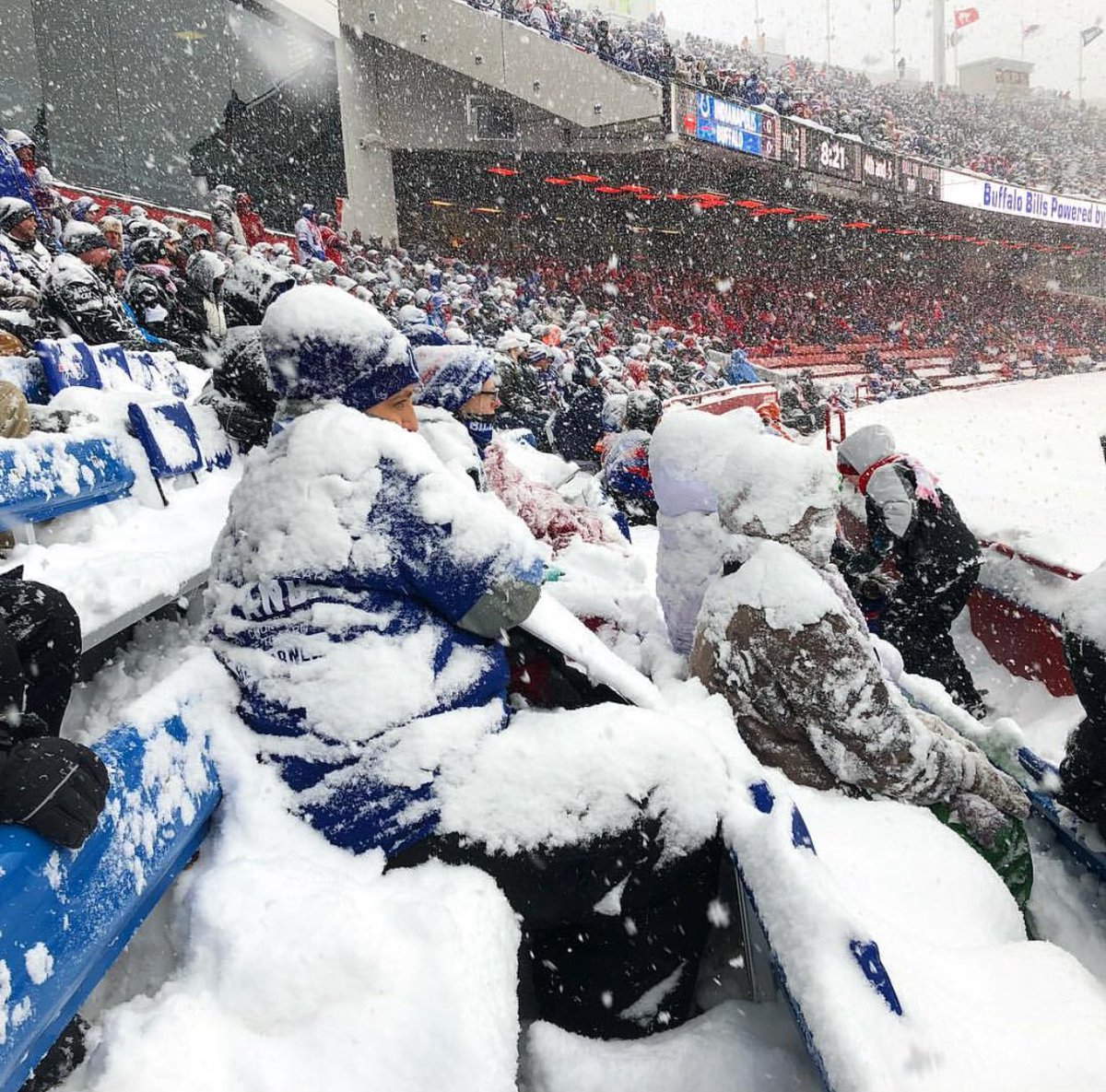
Related image
Buffalo Bills fans dedicated to supporting their football team. #Fortheloveofthegame

Here is the link to the existing Buffalo Sports Museum: 

Links of Buffalo Fans professing their love to our teams:

Thursday, April 26, 2018

Some Further Thoughts...

In my experience, it's always at the end of an academic project that you realize all the other things you could have done and/or paths you could have taken with your research and work.  Not because you were lazy or close-minded about your project and research, but rather that many (some might argue all) academic projects are part of a larger dialogue, and as such they can never truly be complete.

This is the situation I found myself in this morning as I was putting the finishing touches on my final thesis paper, Recommendations for Redesign: Revising the Rochester Museum and Science Center's Native Peoples of the Americas Exhibit.  As a result, I thought of a few possible directions my research and project could have moved in had I had more time to continue with this project before I graduate. 
  • Further research in the Rochester Museum and Science Center's (RMSC) institutional records to gain a better understanding of the history and development of Native Peoples of the Americas and other exhibits at the RMSC, and to resolve some questions left unanswered in my paper, such as specific dates and persons responsible for different parts of the exhibit.
    • As another/further project, perhaps research and write a more comprehensive history of the RMSC than the one I utilized in writing my paper.
  • Develop basic, but formal evaluative criteria for both exhibits in need of redesign, and exhibits featuring representations of Native Americans, then use them to re-evaluate the exhibits/institutions I did my case studies on.
  • Visit the National Museum of the American Indian in Washington, D.C. and its satellite institution, the George Gustav Heye Center, in New York, NY, which I did a brief case study on, but was not able to visit in person.
While I wouldn't change anything about my thesis writing process (because that's what it was meant to be, a process), these are simply some possible expansions I would consider undertaking.  Perhaps in future, someone will take my work and improve upon it by doing one or all of these things, and add to the ongoing dialogue about Native representation and redesign in museum spaces.

Tuesday, March 20, 2018

Finding Inspiration... With Fish?

With regards to progress on my thesis, I can keep this update short.
I am continuing to work on writing the various sections of it. By the end of today (March 20)
I hope to only have my introduction/conclusion/implications left to write, and
I will tackle those in the following week.  I have also prepared and presented a first
draft of my thesis poster, which I will work to improve in the coming weeks.


Today I’d like to write a bit about inspiration, specifically how it can be found
in unexpected places.  For example, I would not have expected to find inspiration
for
Native Peoples of the Americas at an aquarium in Canada, but I did.

This past weekend I visited the Ripley’s Aquarium in Toronto, ON, Canada.
While wandering around in their
Canadian Waters exhibit, I noticed that instead of traditional
labels accompanying each tank, there were screens that would rotate through the
various occupants of the tanks and give facts about them.  This, to me, seemed like a
brilliant solution in many respects. For example, it makes updating or correcting information
easier than having to create a whole new label, as the screen could simply be turned off, a
correction could be made in the program, and it could be turned back on with minimal lag time.
Similarly, if there is a large variety of fish in a tank (or, in my case, objects in a case), but
minimal space available for text, then a single scrolling or interactive screen could save space.
And then, if the screen is a touchscreen, this not only gives visitors a low-level interactive to
participate in by scrolling through and looking at the information in “bite-sized” sections, but
allows for greater connections between items (or fish) on display via linking and internal reference.

While it was already my intention to recommend the inclusion of digital and/or touchscreens
to
Native Peoples, if for no other reason than to bring the exhibit firmly into the 21st century
and provide visitors with a “moving” or interactive element, having seen them in action in a
museum setting (I believe that, as formal collecting institutions, aquariums and zoos should
be considered part of the larger museological family) confirms my initial belief that they
might be a good solution for the RMSC.
A pair of sharks swim past at the Ripley's Aquarium in Toronto, Ontario, Canada.

Saturday, November 18, 2017

From "Thoughts" to "Defrost": The Evolution of My Thesis Project Thus Far

A lot can change in thirteen weeks, and that has certainly been the case for my thesis project.  When I initially conceived my project, I intended to devise ways to redesign or alter not one, but two, of the Rochester Museum and Science Center’s (RMSC) Native American history exhibits (Native Peoples of the Americas and At the Western Door) to bring them in line not only with the other exhibits at the RMSC, but also with the RMSC’s mission to “[stimulate] broad community interest and understanding of science and technology, and their impact — past, present, and future — on our lives.”  The changes I envisioned were largely thematic and one possible solution I wanted to put forth was the potential deaccessioning of the RMSC’s Native American materials to an institution (or institutions) with a more appropriate mission(s).
However, as I began to discuss my ideas with others and read sources for my literature review, it became apparent that there is a much larger issue to be addressed with regards to Native Peoples of the Americas and exhibits like it, specifically the representation they provide of Native Americans and their diverse cultures.  Most Native American exhibits in smaller, traditional museums like the RMSC are outdated, not just in appearance and modes of presentation, but in the ideas they present about Native American cultures.  Many institutions have exhibits that have not been thoroughly reviewed and updated since the 1950s or even the 1900s, when the belief was that Native Americans-- and their cultures-- were going extinct and needed to be preserved, thus resulting in the “freezing” of Native American cultures.  While this is not necessarily the view espoused by the RMSC’s exhibits, the exhibits still depict solely “frozen” cultures, rather than historical and modern representations together.
Because of these revelations, I have elected to shift my topic to focus on ways that the RMSC can “defrost” Native Peoples of the Americas (the older of the two exhibits, with many more “frozen” depictions of cultures and outdated methods of representation).  My goals moving forwards are to conduct a detailed survey of the current exhibit in order to understand specific areas and design elements that need to be addressed, speak with museum administrators and staff to gain a better understanding of how they might envision the exhibits be redesigned or altered, and take a deeper look into methods of redesign that have been put forth by other museum professionals, historians, and Native American activists.  The end results of this work will most likely take the form of a proposal for the redesign of the Native Peoples of the Americas, to be submitted to collections and exhibitions staff at the RMSC for their consideration as they move forward with redesigning some of the museum’s exhibits over the next 5 years.

Sunday, October 1, 2017

Native Peoples of the Americas, Redux: The Plan

Every thesis, or any research project, for that matter, begins with a working research question.  Now, this question may change and develop as research progresses and new information is brought to light or new ideas form, however, it helps to begin with a fairly concrete idea.  In the case of my thesis, this idea was that the Rochester Museum and Science Center’s (RMSC) history exhibits seem out of place, both within the museum’s mission and their physical space.  To narrow this down further, the Native Peoples of the Americas exhibit appears especially outdated (both in terms of theme and method of display) and incongruous when compared to other parts of the museum, even its fellow history exhibits.  This leads me to ask the following question.  In what ways can Native Peoples of the Americas be altered or redesigned to better fit with the RMSC’s mission, both present and future, and visitors’ expectations for the museum and their experience within it?
In order to answer this question, I will need to conduct research in three different areas. To begin, I will review the existing body of literature on the history of display and representation of Native Americans in science museums in order to better understand the history of this practice, as well as how other museums are adapting/changing their Native American exhibits to bring them in line with both their current missions and modern understandings of native culture.  I will then interview key members of museum staff to gain insight into what they view the future direction of the RMSC as a whole to be, and what changes they might envision for the exhibit moving forward.  Next, I will survey visitors to this exhibit about their visit experience within the exhibit, how they feel this experience fits into their overall experience at the RMSC, and what changes could occur to the exhibit to improve their experience.
The end result of this research will be a set of recommendations for the exhibitions and curatorial staff of the RMSC, synthesized from all three sources of research, regarding how best to alter and/or redesign Native Peoples of the Americas, if and when it becomes a priority to do so in the near future.