After a month of getting discouraged and stressing about my case studies, I think I'm finally ready to get back into it. I think last semester I was doing way too much and not giving myself any breaks so when break finally rolled around I just completely stopped and wasn't ready to start back up again when January 13th rolled around. That being said I think I've made a little bit of progress over the last month and I kind of know the direction I'm going into. As of our class meeting on Thursday, I wasn't completely solid on what my second case study would be but now that I've had my board meeting I have a direction and lots of emails to send!
As of today I'm planning to use the RMSC and the Strong Museum of Play as my two case studies. I chose these two after some suggestion from my committee. They are both AAM accredited and they market to the same audience. Choosing two Rochester area museums to compare seems like a very achievable project to me and isn't too out of the scope of what I'm capable of with our time limit. I'm excited to get into it because that means I get to visit my favorite museums in the area very often over the next few weeks!
Getting started on writing the 8 pages was pretty terrible. I know Dr. Lent said that the first effort would be bad but right now I feel like i'm just typing word vomit but it still feels good to finally start writing.
Showing posts with label The Strong National Museum of Play. Show all posts
Showing posts with label The Strong National Museum of Play. Show all posts
Tuesday, January 28, 2020

Saturday, March 19, 2016
Pinball Survey
Since my last post, "Pinball Prologue," I have narrowed the scope of my thesis, created a survey to code and quantify data about pinball machine artwork, and discovered additional sources that will aid me in conducting my analyses (both quantitative and qualitative). According to my abstract, my analysis is meant to "[document] how the depiction of women has or has not changed in pinball artwork over time, and what it might mean today for a [pinball] industry to depend on the visual sexualization of women for its commercial success."
Before I decided to do a quantitative survey, I was going to examine machines from 1930 to present. Once I decided I was going to do a more thorough investigation in a narrower time frame, 1970-1989, I estimated how many survey entries I would have, total, based on the number of pinball machines produced by six major manufacturers. That early estimate revealed I would average 30 entries per year, for an approximate total of 300 machines! I would need to find a way to make the sample size smaller if I was going to complete the survey by the end of spring break.
I also decided I would eliminate entries that did not reach a certain production number, since very limited quantities meant less visibility in the public sphere, but I wasn't sure where that "cut-off" number would be.
So, during yesterday's meeting with my primary advisor, Dr. Tamar Carroll, we considered several ways to refine the quantitative survey parameters to make the selected sample more manageable. In addition to what I discussed above, we decided to eliminate one of the manufacturers from our criteria. Chicago Coin was not as competitive in the pinball market during the 1970s as it had been in prior decades, and production numbers were hard to come by. Stern was not as competitive in the 1970s as the other major manufacturers, so while it would be a huge oversight to exclude them from an analysis of the 1980s, onward, it doesn't seem unreasonable to exclude them in my sample. This is a tough decision and I would be more comfortable making it after a discussion with my secondary advisor.
I discovered early on that despite having different titles, many pinball machines form 1970 to 1978 shared the same artwork with another title. There might have been 2 to 4 machines with the same artwork, because in order to create certain features within electro-mechanical pinball machines, like the ability to add-a-ball OR a replay as a reward, different machines had to be produced to accommodate these features (this began to change with the introduction of solid state electronics in 1977). Duplicate machines with different titles were also produced when a company made a two-player and four-player version of the same game. Sometimes games for foreign markets also received a new title. In all of these instances, because I was focusing on the artwork, I could use the earliest example of the artwork as the baseline for the entry, and simply note 1) how many machines were produced with the same artwork; and 2) list alternate titles within that single entry.
Combined, these methods of narrowing my survey tell me what to prioritize. After all, I can always add entries if I have the time to do so. For now, I should be conservative and develop a solid survey for analysis.
I have also changed my survey sample "questions" from an original set, to a set based on sociologist Erving Goffman's survey in Gender Advertisements, then back to my original set (with revision) again! Although Goffman's survey seemed like a neat ready-to-use package of period-appropriate questions for gender analysis, they were neither as straight forward, nor as appropriate for my thesis, as I originally thought they would be. After receiving positive feedback on my initial set of questions, including suggestions for improvements, I decided I would move forward with those.
My primary advisor and I will meet more regularly following Spring Break to ensure my survey and the thesis, overall, are on the right track.
Finally, there is one more event worth mentioning here. From December to February, I assisted the development of a pinball timeline to be used in conjunction with Pinball Playfields, a permanent exhibit at The Strong National Museum of Play, which opened on February 27, 2016. The timeline is called "Pinball in America." It exists as an interactive display on the exterior of the exhibit space at The Strong, and as an online exhibit, though the Google Cultural Institute. That version is embedded in The Strong's web page (linked above). In addition to the timeline, there are interpretive texts and displays throughout the exhibit that I can now utilize as additional sources for my thesis! What an exciting time.
What's next? While I have also made progress in writing the body of my thesis, there is still a long way to go! First I will focus on completing the survey, then I will continue writing content.
Before I decided to do a quantitative survey, I was going to examine machines from 1930 to present. Once I decided I was going to do a more thorough investigation in a narrower time frame, 1970-1989, I estimated how many survey entries I would have, total, based on the number of pinball machines produced by six major manufacturers. That early estimate revealed I would average 30 entries per year, for an approximate total of 300 machines! I would need to find a way to make the sample size smaller if I was going to complete the survey by the end of spring break.
I also decided I would eliminate entries that did not reach a certain production number, since very limited quantities meant less visibility in the public sphere, but I wasn't sure where that "cut-off" number would be.
So, during yesterday's meeting with my primary advisor, Dr. Tamar Carroll, we considered several ways to refine the quantitative survey parameters to make the selected sample more manageable. In addition to what I discussed above, we decided to eliminate one of the manufacturers from our criteria. Chicago Coin was not as competitive in the pinball market during the 1970s as it had been in prior decades, and production numbers were hard to come by. Stern was not as competitive in the 1970s as the other major manufacturers, so while it would be a huge oversight to exclude them from an analysis of the 1980s, onward, it doesn't seem unreasonable to exclude them in my sample. This is a tough decision and I would be more comfortable making it after a discussion with my secondary advisor.
I discovered early on that despite having different titles, many pinball machines form 1970 to 1978 shared the same artwork with another title. There might have been 2 to 4 machines with the same artwork, because in order to create certain features within electro-mechanical pinball machines, like the ability to add-a-ball OR a replay as a reward, different machines had to be produced to accommodate these features (this began to change with the introduction of solid state electronics in 1977). Duplicate machines with different titles were also produced when a company made a two-player and four-player version of the same game. Sometimes games for foreign markets also received a new title. In all of these instances, because I was focusing on the artwork, I could use the earliest example of the artwork as the baseline for the entry, and simply note 1) how many machines were produced with the same artwork; and 2) list alternate titles within that single entry.
Combined, these methods of narrowing my survey tell me what to prioritize. After all, I can always add entries if I have the time to do so. For now, I should be conservative and develop a solid survey for analysis.
I have also changed my survey sample "questions" from an original set, to a set based on sociologist Erving Goffman's survey in Gender Advertisements, then back to my original set (with revision) again! Although Goffman's survey seemed like a neat ready-to-use package of period-appropriate questions for gender analysis, they were neither as straight forward, nor as appropriate for my thesis, as I originally thought they would be. After receiving positive feedback on my initial set of questions, including suggestions for improvements, I decided I would move forward with those.
My primary advisor and I will meet more regularly following Spring Break to ensure my survey and the thesis, overall, are on the right track.
Finally, there is one more event worth mentioning here. From December to February, I assisted the development of a pinball timeline to be used in conjunction with Pinball Playfields, a permanent exhibit at The Strong National Museum of Play, which opened on February 27, 2016. The timeline is called "Pinball in America." It exists as an interactive display on the exterior of the exhibit space at The Strong, and as an online exhibit, though the Google Cultural Institute. That version is embedded in The Strong's web page (linked above). In addition to the timeline, there are interpretive texts and displays throughout the exhibit that I can now utilize as additional sources for my thesis! What an exciting time.
 |
| Stern Pinball Cluster in the Pinball Playfields exhibit at The Strong National Museum of Play. Press photographs of the exhibit, like this one, capture interactions visitors have with pinball machines and other visitors. Staged or not, the content of this photograph demonstrates the behavior that is expected from museum visitors within the exhibit space. Is female participation contingent upon their relationships with male players? Look closely and you can see two individual female players in the back row. |
 |
| The exterior of the Pinball Playfields exhibit at The Strong National Museum of Play. Photograph taken by author. The digital display that features the Pinball in America timeline is out of the frame, on the right side of the exhibit. Can you believe this used to be a gift shop for butterfly-related merchandise? I'd call this an upgrade. More exhibits mean more opportunities for play, and more play means more opportunities to learn and grow. |
What's next? While I have also made progress in writing the body of my thesis, there is still a long way to go! First I will focus on completing the survey, then I will continue writing content.
Thursday, December 10, 2015
Two-Pronged Approach
On November 30, I had an opportunity to visit Vintage Pinball in Del Ray, Florida. It is a commercial establishment with coin operated machines (mostly pinball) from the 1960s and 1970s. Some of the machines are for sale. Inside there are three rooms filled with pinball machines set to free-play, about 30 in all. Due to family obligations I wasn't able to spend as much time as I would have liked, but for $10.00 a customer can spend as much time as they like there (even come and go). Being exposed to machines and actually being able to play them is far superior to reading about them in books. When you are a player you get the full experience and see the moving parts in action, including how the ball interacts with the artwork-covered environment. There are subtle details that are easy to miss, and some of the mechanisms in pinball machines are so unique, it is hard to understand them from text alone. From this experience, I have concluded that for any machine I want to examine in depth, I should have at least some hands on experience. If that is not possible, I will look online to see if there are any videos of people playing the machine. I am also curious about people's first-time impressions and reactions to machines when they are released, but this information could be tricky to come by for half-century old machines!
The past two weeks have been packed with projects, papers, and presentations. Even when I was traveling, I was working on assignments. I am looking forward to intercession, not because I won't have to do work (on my thesis), but because I can really focus on it without competing coursework for a few weeks! There is another important project I am working on concurrently, outside of RIT, but at least it is somewhat related to my research. I also hold an internship at The Strong, where I am currently working every Friday in the Archives.
During the intercession in December and January, I will spend most of my time doing collections and archival research at The Strong National Museum of Play, where many of my pinball sources come from. I have been thinking about which machines in particular will be good subjects for my thesis. The Strong has many machines, but not all of the ones I would like to examine. That is where the library and archives will come in handy! Monday through Thursday (with the exception of holidays), I would like to put in 3.5 hours of thesis research, followed by 4 hours of internship work. (Fridays will remain the same, with 7.5 hours of internship work.) At first I thought it would be excessive, but I have a long way to go! It is better to put the time in now than to wish I had later.
Since I do not have a lot of prior knowledge in women's studies, I will also need to begin reading some current texts as well as foundation texts that inform the field today. I might have a better idea which sources best suit my needs once I meet with my advisors. Their suggestions may help me narrow my scope and choose key topics that will point to where I need to look. I will do this reading in the evenings and on weekends. Once I have gathered enough pinball-related material for my thesis, I can focus more heavily on women's studies. The more I think about it, it seems a bit "backwards"-- how can I examine the material with a critical feminist lens before having fully developed one? Since I will not be able to spend a lot of time at The Strong during Spring semester, I have to get that time in now.
My goals for intercession are to "complete" most of my pinball-related research and read at least one long women's studies text.
My goals for intercession are to "complete" most of my pinball-related research and read at least one long women's studies text.
In addition, I have come up with a primitive overall plan of work:
December 21-31: Research at The Strong - Books and Magazines, Collections
January 1-15: Blogs, Magazines, Articles, Exhibits Research, Finalize Outline
January 16-31: Update outline. Women’s Studies Research - Books & Scholarly Articles
February 1-15: Update outline. Begin Rough Draft using research notes.
February 16-29: Primary and Secondary Read Draft, Feedback, Revision
March 1 -15: Primary and Secondary Read Draft, Feedback, Revision
March 16-31: (Spring Break) Travel if necessary, otherwise continue writing.
April 1-10: Primary and Secondary Read Draft, Feedback, Final Revision
April 12-16: Finishing Touches on Thesis (DUE WEEK 12 / April 12-16).
Thursday, September 10, 2015
Initial Thesis Concept, Melissa Fanton
Magnetic storage media has a short life cycle, but the complexity of its preservation has been an obstacle to creating standard preservation practices, which are still in their infancy. Many museums and archives with magnetic storage media seem to be waiting for the right "conditions" to begin preserving the content stored within (affordable storage, best practices, the right software and hardware), but predicted life cycles for most magnetic storage media are 30 years or less (under optimal storage conditions). Those floppy disks in the collection? They're "dead". Those VHS tapes? They're dead, too. Those video game cartridges? Dead. While paper materials are being digitized to improve accessibility, magnetic media deteriorates, threatening the existence of the content within.
My original goal was to read the current research and construct an argument that there are preservation solutions, we (in the museum field) simply don't prioritize these types of collection items. Museums will often accept these items into their collection without testing them due to time, labor, and equipment limitations (is the data in tact, "uncorrupted", and accessible?).
With a much narrower focus (specific type of media, specific type of institution or collection), I thought I would be ready to begin, however, it just doesn't feel right. A senior thesis isn't just supported by research; it is supported by four years of undergraduate education and other experience. Have I prepared myself to write about such a topic, even from a museum collections intern perspective? In some respects, yes, in others, not at all. My "gut" tells me I will be spending more time educating myself on fundamental concepts related to my topic than doing targeted, in-depth research and writing. Will I be mid-way through the process before my brain finally cries "does not compute!?" Before I make a decision to commit to this topic, I will need to do more research.
Since this idea stemmed from a concern with preserving video game software and hardware in museum collections, I have included the video I will be watching next. The video below is part II of a panel discussion hosted by the Smithsonian American Art Museum "focused on how to conserve and preserve digital media, specifically video games..." One of the members on the panel is J. P. Dyson, Director of the International Center for the History of Electronic Games (ICHEG) and VP for Exhibits at The Strong from The Strong National Museum of Play.
Thursday, September 3, 2015
Hello, I'm Melissa.
Before I begin posting regularly, I would like to introduce myself. My name is Melissa Fanton, and I am a fourth-year museum studies student at RIT. Since becoming an intern at The Strong National Museum of Play, my interest in Collections Management has blossomed and I hope to pursue a thesis topic related to collections. The collections at The Strong are too interesting not to study in more depth, and their library and archives can provide many high quality sources. Thank you for reading, and stay tuned for more in the coming months.
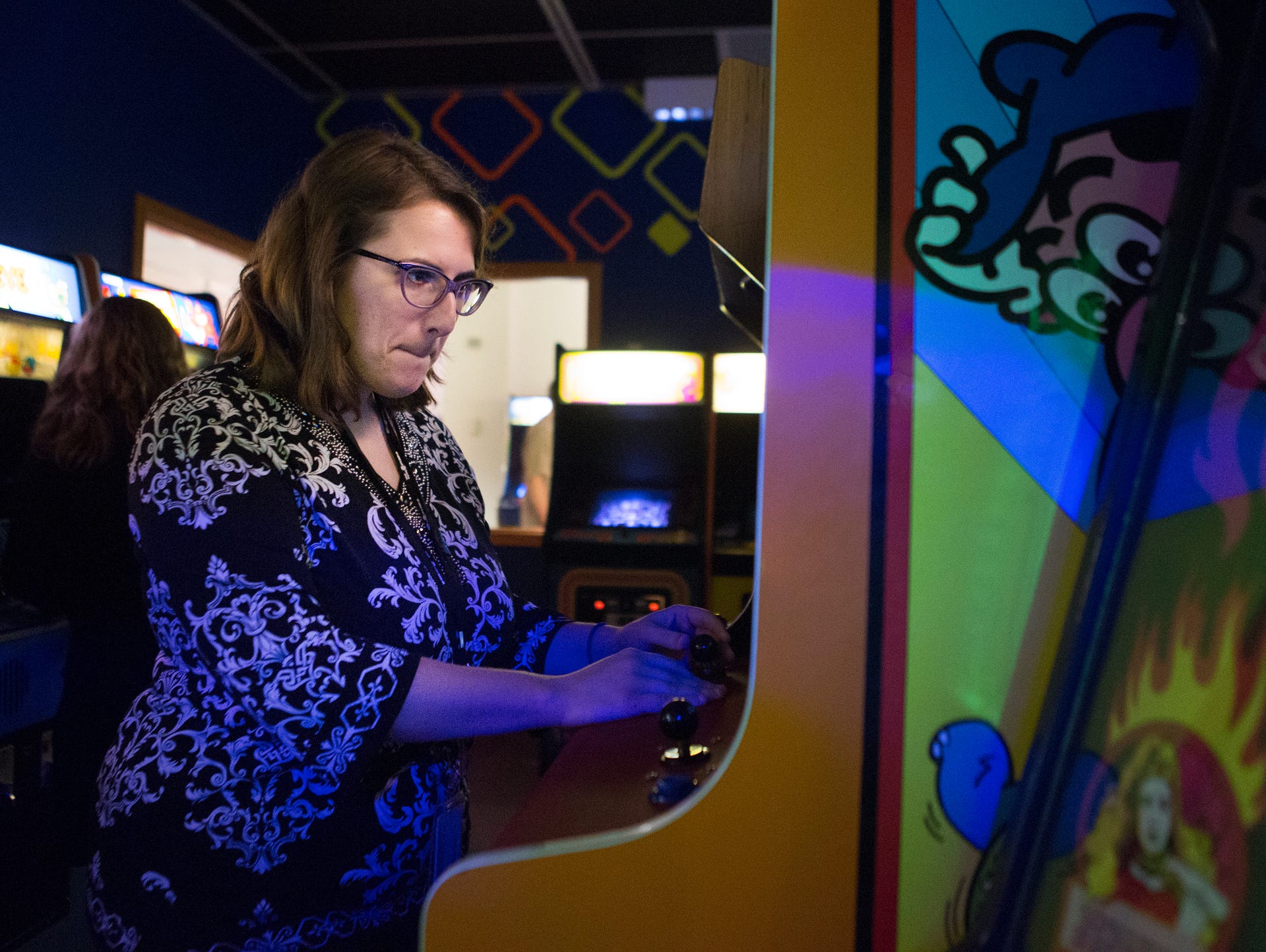 |
| A photograph of me during my internship at The Strong. The image depicts me playing Super Mario Bros. on the day of the World Video Game Hall of Fame induction ceremony. This photograph was taken by RIT alumni Lauren Petracca, staff photographer for the Democrat & Chronicle. From the Democrat & Chronicle, June 4, 2015. Article can be found online here. |
Subscribe to:
Posts (Atom)