I can't believe we're already approaching week 3! With school back in full swing, I've been doing a lot of research on the preservation of the Scottish Gaelic language and trying to uncover case studies in which cultural institutions in Scotland contribute to the language's preservation and revitalization. As I've mentioned, I decided to focus on Scottish Gaelic for my research, rather than doing all three (Scottish Gaelic, Irish, and Welsh). The reasoning behind this is to focus my research and delve in deep without overwhelming myself, especially given the thesis deadlines and how fast the semester will go by. I spent my winter break gathering preliminary sources on Scottish Gaelic, and now I'm working on reading through them and refining my searches.
As I look ahead, I believe my challenge will be trying to define success in order to propose suggestions for how museums can preserve and revitalize endangered languages. Because this seems to be a relatively new area of study (the intersection of cultural institutions and endangered languages), the possibilities are exciting, but it also makes it difficult to evaluate shortcomings and successes. For example, there are language policies that have been enacted within the past couple years. But, if success were to be hypothetically based on number of speakers, you'd have to wait for the next generation to grow up to see if they're passing on the language to their children and compare that to the number of speakers before the language policies were put in place. Or, I could base success on something more in the moment, like visitor engagement in cultural institutions with bilingual signage, for example.
I'm keeping all of this in the back of my mind as I research. I'm hoping that the more I read and find case studies the clearer this will become. I am also considering reaching out to museums to inquire about more information on Scottish Gaelic from their viewpoints of actually interacting with the public in Scotland.
Showing posts with label #ResearchMethods. Show all posts
Showing posts with label #ResearchMethods. Show all posts
Saturday, January 26, 2019

Wednesday, December 5, 2018
Getting ready for winter break
Instead of wasting my days with Netflix, I hope to be very productive over this winter break!
I have several goals that I hope to accomplish before the end of the break. First, I want to polish off my literature review. I want to add a few more sources that I couldn’t include because I ran out of time, and I’m sure that I will have a lot of feedback to work with after the museum studies faculty review my thesis proposal (yikes!!). Secondly, I would like to schedule a meeting with my thesis advisers so I can make sure I have a good plan of action to complete my thesis and begin a more in-depth outline for the rest of my paper. Hopefully, I can bribe them with coffee so they will meet with me before the semester starts!
The largest goal I hope to accomplish over break is completing all of the elements of my app. My partner Peter and I already have a timeline in place, and thus far we’ve been meeting all of our goals, so I don’t see this being an issue.
Thankfully, I will be working on campus over the break, so I plan to spend at least an hour on campus doing work after I finish my shift. Once I’m in work-mode it’s easier to keep the ball rolling, so I think that this will end up working really well for me. I get out of work in the early afternoon and could easily be home before 5pm every day even after staying to work on my thesis. I also set personal deadlines for myself and use a daily planner, so that organization should help me keep on track and put me in a good place to start the spring semester.
It’s hard to believe I’m essentially halfway finished with my thesis. It’s exciting and nerve-wracking at the same time!
I have several goals that I hope to accomplish before the end of the break. First, I want to polish off my literature review. I want to add a few more sources that I couldn’t include because I ran out of time, and I’m sure that I will have a lot of feedback to work with after the museum studies faculty review my thesis proposal (yikes!!). Secondly, I would like to schedule a meeting with my thesis advisers so I can make sure I have a good plan of action to complete my thesis and begin a more in-depth outline for the rest of my paper. Hopefully, I can bribe them with coffee so they will meet with me before the semester starts!
The largest goal I hope to accomplish over break is completing all of the elements of my app. My partner Peter and I already have a timeline in place, and thus far we’ve been meeting all of our goals, so I don’t see this being an issue.
Thankfully, I will be working on campus over the break, so I plan to spend at least an hour on campus doing work after I finish my shift. Once I’m in work-mode it’s easier to keep the ball rolling, so I think that this will end up working really well for me. I get out of work in the early afternoon and could easily be home before 5pm every day even after staying to work on my thesis. I also set personal deadlines for myself and use a daily planner, so that organization should help me keep on track and put me in a good place to start the spring semester.
It’s hard to believe I’m essentially halfway finished with my thesis. It’s exciting and nerve-wracking at the same time!
Tuesday, December 4, 2018
Blog Post VII: Winter Break Plans
I plan on taking full advantage of the break and first giving myself some time to rest and relax. Allowing myself some time away from my thesis will be beneficial I think because I can then return to it with fresh eyes and ideas. After the holiday, during the second half of the break, I plan on doing some more reading and seeing if I can ascertain whether I need to focus on one language for my case study (Scottish Gaelic, Irish, or Welsh) or if it’s feasible to do all three. If I can figure this out, or at least begin to, over break by looking at some initial resources then I can jump right in during spring semester. And of course I’ll be working on my literature review after receiving feedback from my advisers so that I can get in the revised version for them to sign.
Overall, I’m just really looking forward to going home and seeing my family (and my dog!). It’ll be nice to be able to just focus on thesis without the assignments/projects/tests of other classes. I will be able to allocate more time to my research in this way and also get some new perspectives from my family who will be curious about my thesis.
I can’t believe we’re halfway through our senior year!
 |
| Here's a cute picture of my dog to help ease the stress of these last few days of the semester! |
Wednesday, November 28, 2018
The evolution of my thesis
Since the first time I voiced my thesis idea, my project changed significantly. Originally, I thought I wanted to create a sensory-friendly toolbox that one could use in any museum across the country. I had a very large, vague and well-intended idea to provide sensory-friendly games on an app that could enable people to experience a museum without having to go during special hours or on certain days of the week. After a lot of discussion with my adviser and app consultant, I realized that making a large, general app containing only games and music wouldn’t be able to accomplish my end goal, and I may not be able to accomplish it period because of the large scope. Now, I’m focusing on creating an app for one area of one museum, Strong Museum of Play, that not only provides games and music, but also a social narrative, a sensory map, and other helpful information about the museum. I also now plan to go beyond just making the app and hope to conduct focus groups where individuals with autism and their family members can interact with the app and give me feedback so I can make suggestions for further improvements.
While much of my project is set in stone and concrete, my final stage, the focus groups, is where I see the project truly evolving. Based on my research, this app should be successful and helpful for people on the spectrum, but I won’t truly know that until I actually have people interact with it. I hope it won’t, but the app could be a failure. As the project moves forward and evolves, this determination will steer my paper in one of two ways: creating an outline of what a successful app for individuals with autism looks like and evaluating the effectiveness of personal technology in helping increase accessibility, or outlining what didn’t work and provide insight from my personal experience on how apps aimed at making museum experiences accessible can be tailored to best serve the intended audience.
The research never ends...
One thing I’ve learned through working on this project is that the research process truly never ends. Every time I think I’m close to being done, I find a few more things that could be improved with more research and more sources.
So far, I've learned a lot through my research, one of the most important things being the intricacies of autism spectrum disorder. Because of my experience interacting with my little cousin Leo, I thought I had learned a lot about what autism spectrum disorder was. However, I truly had no idea about the finer details. I knew that Leo had trouble with communicating, staying focused on the appropriate tasks, and sitting still for too long, but I didn’t know why he has difficulties with these things. Learning about the difficulties people with autism have with sensory processing gave me a concrete answer as to why Leo, and other people on the autism spectrum, have this issues. Knowing why people with autism react negatively to certain stimuli is the only way I can effectively craft an app that helps individuals cope with these negative, overwhelming feelings. Without this knowledge, my project would fall short and seem incomplete.
I still need to learn more about what museums, in particular, are doing for individuals with autism. Thus far, I’ve found a lot of information about sensory friendly days and pre-visit materials the museum provides for families of individuals with autism, but I haven’t found much on the use of technology within a museum to increase accessibility. I’ve found a lot of information about apps and online programs that help facilitate communication and interaction for individuals with autism, but only one of them can specifically operate within the space of a museum. As I continue researching, I hope to find more sources discussing accessible technology for people on the autism spectrum within the space of a museum.
So far, I've learned a lot through my research, one of the most important things being the intricacies of autism spectrum disorder. Because of my experience interacting with my little cousin Leo, I thought I had learned a lot about what autism spectrum disorder was. However, I truly had no idea about the finer details. I knew that Leo had trouble with communicating, staying focused on the appropriate tasks, and sitting still for too long, but I didn’t know why he has difficulties with these things. Learning about the difficulties people with autism have with sensory processing gave me a concrete answer as to why Leo, and other people on the autism spectrum, have this issues. Knowing why people with autism react negatively to certain stimuli is the only way I can effectively craft an app that helps individuals cope with these negative, overwhelming feelings. Without this knowledge, my project would fall short and seem incomplete.
I still need to learn more about what museums, in particular, are doing for individuals with autism. Thus far, I’ve found a lot of information about sensory friendly days and pre-visit materials the museum provides for families of individuals with autism, but I haven’t found much on the use of technology within a museum to increase accessibility. I’ve found a lot of information about apps and online programs that help facilitate communication and interaction for individuals with autism, but only one of them can specifically operate within the space of a museum. As I continue researching, I hope to find more sources discussing accessible technology for people on the autism spectrum within the space of a museum.
Monday, November 26, 2018
Blog Post VI: From Conceptualization to Fruition
The main topic of my thesis has remained the same, but throughout the past few weeks, I’ve gained more clarity on how to approach my research project. At the beginning, I knew I wanted to focus on endangered languages in the United Kingdom and Ireland for the case studies of the main body of my thesis. Therefore, I wasn’t quite sure what case studies or examples to discuss in my literature review without being redundant. I decided to just do some general research on language preservation and revitalization as a general subject/area of study. Ultimately, this ended up being a successful strategy because I found some great core readings on the subject which helped shape my lit review. A couple of my sources were written by linguist Leanne Hinton, who mentioned a few workshops here in the U.S. involving Native American tribes and museum institutions, which I discuss in Blog Post V. I had heard of these before in my own personal research during the past year, so I thought it would be great to discuss them as examples of current museums efforts in the U.S. which will set up a nice segway into a discussion comparing and contrasting them to my case studies in the U.K. Furthermore, I’ve been inspired by one of my linguistics classes, Evolving English Language, to include a section about the spread of English and how it affects other languages. Overall, not overthinking or narrowing my initial research and keeping my mind open have really helped my process.
I can see my thesis evolving quite a bit as I uncover how much information there is about Celtic languages (Scottish Gaelic, Irish, Welsh). If there ends up being a lot of information to work with (concerning policy, community programs, museum efforts) I may end up just focusing on one of the languages and delving in deep. If there is not a significant amount of information, I will have to figure out how to best survey language preservation and revitalization efforts. However it ends up, I’m excited to see how cultural institutions can help and hopefully present some novel ideas and methods to both fields (museums/linguistics).
 |
| This is a diagram I found after searching in Google "Celtic Languages." The map, from the Brilliant Maps site, is helpful to situate oneself as to where the languages in my case studies are mainly located. It also includes some statistics, although they are not cited. |
Thursday, September 27, 2018
Articles on 3D Printing in Museums
Mostly, what I learned from the close reading of my two articles is that my topic isn't one that's been explored very much. Neither of the articles I read, "Flip-flopping museum objects from physical to digital - and back again" and "3D printing and 3D scanning of our ancient history" related exactly to what I want to research for my thesis project. The first article discussed a case study in which visitors were allowed to scan, remix, and then 3D print sculptures at an art museum in Denmark, while the second was about the importance of having 3D facsimiles and scans of Iraqi artifacts available so that the people of Iraq can understand their cultural heritage. The articles didn't give me a ton of information on my topic, but both provided insight into how academic articles should be written.
The first article I read ("Flip-flopping museum objects from physical to digital - and back again") was laid out very clearly, with each section defined, and all potentially unknown concepts explained for the reader. This is the type of article I would like to emulate with my own thesis; something that's clear and understandable for the reader. The second article I read however, was not particularly clear. There was little evidence to back up the author's points, and most of the article was devoted to discussing important Iraqi achievements, which was interesting, but not related to how 3D printing can help preserve cultural heritage. These two articles therefore gave me more insight into the format and shape I want my thesis to take rather than the content itself, but I still feel it was valuable.
Both articles also provided interesting information about the research methods employed. For the first article, the author detailed how she spent eight weeks observing visitors to the museum who interacted with the 3D remixing and printing of sculptures. She discussed observing them, in some cases interviewing them, and how this provided insight into the visitor experience. This also felt important to me, as I'm hoping to complete a visitor experience study as part of my thesis. The second article meanwhile, didn't provide much insight into the research methods employed. The authors cited some books and journals, but that was all they detailed about their research methods. This made it hard to gain insight, since I'm not entirely certain what methods they used to do research for this article.
Overall, I found these articles to be interesting, even though they didn't necessarily relate to my topic. One thing that was really helpful however, was looking at their citations. Both articles cited sources that I think might be beneficial for me to look at, as they seem to relate more to my topic. These articles gave me helpful insight into what research methods I can employ for my own project, and I'm excited to continue researching and working to develop my thesis idea.
Sources:
Article 1: Lisa Skytte Jakobsen, "Flip-flopping museum objects from physical to digital - and back again," Nordisk Museologi 2016, 1 (2016): 121-137
Article 2: Al-Baghdadi, Maher A. R. Sadiq, "3D printing and 3D scanning of our ancient history: Preservation and protection of our cultural heritage and identity," International Journal of Energy and Environment 8, 5 (2017): 441-456
The first article I read ("Flip-flopping museum objects from physical to digital - and back again") was laid out very clearly, with each section defined, and all potentially unknown concepts explained for the reader. This is the type of article I would like to emulate with my own thesis; something that's clear and understandable for the reader. The second article I read however, was not particularly clear. There was little evidence to back up the author's points, and most of the article was devoted to discussing important Iraqi achievements, which was interesting, but not related to how 3D printing can help preserve cultural heritage. These two articles therefore gave me more insight into the format and shape I want my thesis to take rather than the content itself, but I still feel it was valuable.
Both articles also provided interesting information about the research methods employed. For the first article, the author detailed how she spent eight weeks observing visitors to the museum who interacted with the 3D remixing and printing of sculptures. She discussed observing them, in some cases interviewing them, and how this provided insight into the visitor experience. This also felt important to me, as I'm hoping to complete a visitor experience study as part of my thesis. The second article meanwhile, didn't provide much insight into the research methods employed. The authors cited some books and journals, but that was all they detailed about their research methods. This made it hard to gain insight, since I'm not entirely certain what methods they used to do research for this article.
Overall, I found these articles to be interesting, even though they didn't necessarily relate to my topic. One thing that was really helpful however, was looking at their citations. Both articles cited sources that I think might be beneficial for me to look at, as they seem to relate more to my topic. These articles gave me helpful insight into what research methods I can employ for my own project, and I'm excited to continue researching and working to develop my thesis idea.
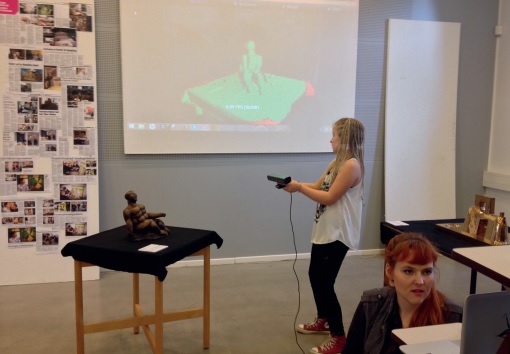 |
| A photo included in the first article of a visitor 3D scanning one of the museum's sculptures. Photo by Lise Skytte Jakobsen (article author). From Flip-flopping museum objects from physical to digital - and back again |
Article 1: Lisa Skytte Jakobsen, "Flip-flopping museum objects from physical to digital - and back again," Nordisk Museologi 2016, 1 (2016): 121-137
Article 2: Al-Baghdadi, Maher A. R. Sadiq, "3D printing and 3D scanning of our ancient history: Preservation and protection of our cultural heritage and identity," International Journal of Energy and Environment 8, 5 (2017): 441-456
Wednesday, September 26, 2018
My relationship with academic writing
Up to this point in the semester, much of our time has been spent coming up with thesis topics and learning more about the general format of academic articles. Now, we get to get our hands dirty with research of our own!
There are three key things I’ve taken away from reading academic articles in preparation for my thesis. The first, presentation is just as important as content. One can have the most exciting and innovative findings in the world, but if the findings are buried in unlabeled charts and figures or hidden in long, dense paragraphs, the point gets lost. For example, I read a paper from the International Journal of Interactive Mobile Technologies, “Fill Me App: An Interactive Mobile Game Application for Children with Autism,” which had a lot of amazing content and an interesting subject, but it was difficult to read and the provided charts and figures were rather vague.
The second takeaway seems rather obvious, but I learned that having a clear and defined structure for a research paper is highly important. Having a clean structure can allow for better readability, and can allow readers to scan and focus on key points to help understand the article.
The third takeaway is more specific to my topic of study for my thesis. For articles relating to the interaction between individuals with autism and technology in the space of a museum, case studies seem to be the most effective form of evidence. Another article I read, “Educational and digital inclusion for subjects with autism spectrum disorders in 1:1 technological configuration,” effectively used case study evidence throughout the article and, in my opinion, it made each of their assertions easier to understand. For each point they made about the interaction between an autistic child and a certain type of technology, the writers would include an anecdote from their research pertaining to a specific child involved in the study. I think this is a technique I may carry over into my own thesis.
As I've read more museum studies research articles, I discovered that they don’t all follow the same format or style, which surprised me. Throughout my time as a student, much of my experience with scholarly articles related to museums can be summed up in three words: dense, heavy essays. However, reading more contemporary work has shown me that the academic writing for museum studies can be just as diverse as the field itself. I look forward to making my own contributions to the field.
1. Marylene S. Eder, John Maruel L. Diaz, Joanne Ruth S. Madela, Marife U. Mag-usara
and Dhally Dith M. Sabellano, “Fill Me App: An Interactive Mobile Game Application for Children with Autism,” International Journal of Interactive Mobile Technologies 10, no. 3 (2016): 56-63.
2. Lucila Maria Costi Santarosa and Debora Conforto, “Educational and digital inclusion for subjects with autism spectrum disorders in 1:1 technological configuration,” Computers in Human Behavior 60 (2016): 293-300.
There are three key things I’ve taken away from reading academic articles in preparation for my thesis. The first, presentation is just as important as content. One can have the most exciting and innovative findings in the world, but if the findings are buried in unlabeled charts and figures or hidden in long, dense paragraphs, the point gets lost. For example, I read a paper from the International Journal of Interactive Mobile Technologies, “Fill Me App: An Interactive Mobile Game Application for Children with Autism,” which had a lot of amazing content and an interesting subject, but it was difficult to read and the provided charts and figures were rather vague.
 |
| Taken from "Fill Me App: An Interactive Mobile Game Application for Children with Autism." |
The second takeaway seems rather obvious, but I learned that having a clear and defined structure for a research paper is highly important. Having a clean structure can allow for better readability, and can allow readers to scan and focus on key points to help understand the article.
The third takeaway is more specific to my topic of study for my thesis. For articles relating to the interaction between individuals with autism and technology in the space of a museum, case studies seem to be the most effective form of evidence. Another article I read, “Educational and digital inclusion for subjects with autism spectrum disorders in 1:1 technological configuration,” effectively used case study evidence throughout the article and, in my opinion, it made each of their assertions easier to understand. For each point they made about the interaction between an autistic child and a certain type of technology, the writers would include an anecdote from their research pertaining to a specific child involved in the study. I think this is a technique I may carry over into my own thesis.
As I've read more museum studies research articles, I discovered that they don’t all follow the same format or style, which surprised me. Throughout my time as a student, much of my experience with scholarly articles related to museums can be summed up in three words: dense, heavy essays. However, reading more contemporary work has shown me that the academic writing for museum studies can be just as diverse as the field itself. I look forward to making my own contributions to the field.
1. Marylene S. Eder, John Maruel L. Diaz, Joanne Ruth S. Madela, Marife U. Mag-usara
and Dhally Dith M. Sabellano, “Fill Me App: An Interactive Mobile Game Application for Children with Autism,” International Journal of Interactive Mobile Technologies 10, no. 3 (2016): 56-63.
2. Lucila Maria Costi Santarosa and Debora Conforto, “Educational and digital inclusion for subjects with autism spectrum disorders in 1:1 technological configuration,” Computers in Human Behavior 60 (2016): 293-300.
Thursday, September 6, 2018
Into the weeds we go...
Before any of my thesis work gets started, I'd like to put it in writing that I genuinely love museums and working in the field. Museums, and the people who work in them, provide invaluable services to the public, and I'm thankful every day that I've been fortunate enough to spend so much time in various institutions. My name is Elisha Muir, and I'm going to spend the next several months of my life trying to figure out how the US tax code affects the operation and governance of non-profit museums. And when that's done, I'm going to law school!
Granted, it's an odd path I've taken, but hopefully by the end of these posts my intentions and analysis will gain clarity, and my reasons for doing something potential dull and far into the weeds will be justified.
 |
| Pictured: me at Imagine RIT presenting with the GCVM |
Wednesday, September 5, 2018
Why Museum Studies?
When I was in elementary school, the teachers every year would ask us what we wanted to be when we grow up? My response was not the typical career choices like a doctor or a fireman. Instead, I told my fourth-grade teacher that I wanted to be a historian and scientist working for a well-established museum. Funny how life turns out. From a young age, I was fascinated by how museums transformed history into an interactive and educational exhibition for people of all ages to enjoy. Museums are a place where history comes alive through illuminating stories from artifacts. These stories associated with ancient artifacts is where I fell in love with museums.
Recently, I had the unique opportunity to work abroad for the National Museum of Ireland for the summer. I was assigned to work with the Natural History and Archeology Collections. My boss and I organized, updated, and in some cases reassigning accession numbers to objects hidden in the crypt. Towards the end of my time in Ireland, my boss had me perform a Collections Audit, where a museum personnel goes through the collection and randomly picks out artifacts to see whether it has been updated into the database system. I loved learning about Ireland’s ancient history through the museum’s tremendous collections through performing the audit.

Wednesday, December 6, 2017
Intersession - Back to the Burchfield
Over the winter break, I plan on taking advantage of the time and location to make at least one visit to the Burchfield Penney archives to continue my research. My research will be driven by the direction my advisors and I decide to go in went we all meet together for the first time on Thursday. A major point of my thesis to resolve is determining what software I will use to develop my database. This discussion is critical to have now in order to make sure it can be supported by the archives. Additionally, the end users will have to be considered - is this going to be used by the archives only or will it be publicly accessible? The answers to these questions will likely lead to proposal revisions and may result in a section being added to the literature review. Research questions to continuously keep in my mind are what categories to include and the what is the scope of the artists' careers that I would like to include. Hopefully, the additional research and consultation will allow me to actually start constructing my final deliverable.
Saturday, December 2, 2017
A Glance Back and a Short Look Forward
Well, this is it. The end of my first semester of thesis work. It seems like only yesterday that I was struggling to sort through all of my potential thesis ideas, yet here I am today, with my initial proposal submitted for feedback, writing my final post of the semester (and of 2017, I suppose). While I have accomplished a lot over the course of the semester, my work on this project is far from finished and a good deal of it will have to be accomplished over the upcoming winter break. This will include conducting interviews with members of the RMSC’s staff and local Native communities, before performing at least one (although it will probably end up being several) thorough survey of the Rochester Museum and Science Center’s (RMSC) Native Peoples of the Americas exhibit, with what I have been told in the interviews in mind (I already completed an initial, cursory survey over Thanksgiving Break). I will also use this time, and the resources that have been provided to me by Kathryn Murano, Senior Director for Collections and Exhibits at the RMSC, to take a more focused look at the history of Native American collections and representation at the RMSC, in order to better understand how this exhibit fits with its fellows across the nation (as briefly outlined in my most current draft of my literature review).
With regards to finding the time to work on all of this, I will, of course, have to work my interviews and exhibit surveys around the various winter holidays that are coming up, and I have a strong suspicion that, in some cases, I will have to wait until at least just after New Year’s to make any major headway with regards to interviews. Thankfully, I will be fairly flexible in my ability to take time to interview people, as I will be staying in Rochester for the entire break and have a semi-flexible work schedule during that time. Because of this, I am not worried about setting a schedule for my thesis work at this time, as it will be easier to work around other people’s schedules than my own.
I’d like to take a moment to thank everyone who has helped me with this process and my project thus far, including Dr. Tamar Carroll, Kathryn Murano, and Dr. Juilee Decker, and wish everyone happy holidays.
 |
| While many of the photographs from my recent survey of the Native Peoples of the Americas exhibit turned out very dark due to the low lighting in the exhibit, my friend Skye Tryon did take this picture of me at the RMSC with a taxidermied pangolin, an endangered African and Asian mammal similar to an armored ant eater. The pangolin is part of The Science of Ripley's Believe It or Not!® exhibit, which is on display at the RMSC until January 2, 2018. |
Monday, November 20, 2017
If you give a student a research question, they'll ask for sources and sources and sources...
As the old story goes, if you give a mouse a cookie, he'll ask for milk, and then a straw, and then a napkin, and on and on and on....and this has been what researching for my thesis has been like. A few questions at first have evolved over thirteen weeks into what feels like hundreds, and although I can't answer them all, they have pushed and nudged my thesis into all kinds of different directions.
In the beginning I asked myself, "how do podcasts function in the realm of public history?," and it seemed simple enough. The idea was to figure out what podcasts accomplish, then see if that fits into what public history accomplishes, but I think you can tell where things start getting a little muddy. Public history is something that, through my research, I have come to realize is very malleable and rather undefined. If you break down the term you understand that it quite literally is history, usually applied by historians or academics, made available for the public, but that encompasses so many things! My task then was then not only figuring out the nature of podcasts, but of public history itself.
This has since changed my research from focusing solely on podcasts, their creators, and their applications. It has led me to incorporate ideas on public history; it's history, it's goals, what it is, and what it can be. This is not to say my thesis will now be a manifesto on the nature of public history, but it means that it has gained a more specific angle that I will be approaching the work of podcasts from. This is not so much an evolution of my original question, since it primarily remains the same, but it gives my topic a more defined path to follow. I see it being a lot easier to focus my hundreds of other questions into elements of these two guiding questions: "What are the goals of historically minded podcasts?" and "What are the goals of public history?"
Tuesday, November 7, 2017
Artpark: What Makes the Experience Democratic?
The essence of my research has been to what extent Artpark functioned as a democratic experiment within the 1970s. However, defining what makes the Artpark experience "democratic" in the first has become problematic. After all, "democracy" is a word with many philosophical and functional connotations. Is it the way artists were selected to complete a residency that is democratic? Or is it how theoretically any member of the public could access the site-specific art and interact with the artist, effectively breaking down the studio walls? The artistic process itself could potentially be framed as democratic as well, especially if artists had control over where and how they executed their ideas.
These were questions I had in mind when I made my visit to the Burchfield Penney archives for research last Friday. Jennifer, the project archivist for the Artpark Archival Collection, told me that approaching the question from certain angles (such as how Artpark and its artists were funded) would require extremely intensive archival investigation. Therefore, she suggested to focus specifically on how Artpark functioned as a democratic experiment only for the artists involved. A topic of interest would be examining the types of institutions representing these artists before they were selected (were they artist-led?). The documents I looked over on Friday provided a good starting point for this investigation. The Visual Arts Program catalogs provided useful biographical information for the artists who currently have little to no presence online. A study conducted in 1978 by Arts Development Associates also revealed significant information, such as how only 30% of artists came to Artpark through a personal connection. According to the study, this proved that Artpark was "not a closed shop." The documents also provided a consistent account of Artpark's vision for the arts in its early years: to encourage the realization of experimental ideas in the arts and to engage the public in unorthodox ways.
Situating Artpark in a greater historical context has provided some interesting insights as well. Artpark was one of many efforts during the late '60s and 1970s to free art from the traditional gallery space, or, as Brian O'Doherty calls it, the "white cube." Artpark was far from being the only alternative art space in Western New York during the 1970s. Hallwalls, which was founded in 1974 (the same year Artpark's programs began), also dedicated itself to featuring innovative works from young artists at the time. I am also researching federal and state funding for the arts during this time period and how that may have influenced Artpark's operations.

These were questions I had in mind when I made my visit to the Burchfield Penney archives for research last Friday. Jennifer, the project archivist for the Artpark Archival Collection, told me that approaching the question from certain angles (such as how Artpark and its artists were funded) would require extremely intensive archival investigation. Therefore, she suggested to focus specifically on how Artpark functioned as a democratic experiment only for the artists involved. A topic of interest would be examining the types of institutions representing these artists before they were selected (were they artist-led?). The documents I looked over on Friday provided a good starting point for this investigation. The Visual Arts Program catalogs provided useful biographical information for the artists who currently have little to no presence online. A study conducted in 1978 by Arts Development Associates also revealed significant information, such as how only 30% of artists came to Artpark through a personal connection. According to the study, this proved that Artpark was "not a closed shop." The documents also provided a consistent account of Artpark's vision for the arts in its early years: to encourage the realization of experimental ideas in the arts and to engage the public in unorthodox ways.
Situating Artpark in a greater historical context has provided some interesting insights as well. Artpark was one of many efforts during the late '60s and 1970s to free art from the traditional gallery space, or, as Brian O'Doherty calls it, the "white cube." Artpark was far from being the only alternative art space in Western New York during the 1970s. Hallwalls, which was founded in 1974 (the same year Artpark's programs began), also dedicated itself to featuring innovative works from young artists at the time. I am also researching federal and state funding for the arts during this time period and how that may have influenced Artpark's operations.

The Burchfield Penney Art Center, the location of the Artpark Archival Collection
Tuesday, October 3, 2017
Relationships Within Artpark and the Question of Its Success as a Democratic Art Space
For my senior thesis project, I intend to develop a relational database of the artists in residency at Artpark throughout its history. I will map out and visualize the network of connections between artists, staff, and the museums and art institutions these artists passed through both prior to and after their time at Artpark. A broad goal of this project would be to better understand the complex interpersonal and institutional relationships involved in the network and how it has evolved over time.
To compile information, I will use annual visual arts program catalogs from the Burchfield-Penney's Artpark Archival Collection as well as other easily accessible, inventoried materials including media releases, surveys, and administrative employee credentials. For example, from the surveys it is possible to tell which artists recommended other artists to come to the park, and from employee credentials it is possible to discern how the staff’s outside institutional relationships may have influenced the network of artists over time. Another dimension we are interested in would be determining the relationship between artists who were selected for the “major project” category (formed for avant-garde artists) and the "crafts" category and how the balance in the numbers between each category has changed over time.
An extensive historical chronicle of Artpark and its significance among outdoor sculpture park has been conducted through the former UB gallery exhibition “Artpark 1974-84.” The thesis for this contextualized Artpark as "a radical experiment in artist-public interaction and site-specificity that successfully balanced a populist mission with the creation of experimental art”(Firmin 2010). According to curator Sandra Firmin, the park welcomed artists of diverse backgrounds and allowed them to experiment with art in a spectacular geographic and mythic location. By uncovering the complex network of relationships between chosen artists, staff, and outside institutions, my working research question will be to determine to what extent Artpark adhered to its populist principles. To what extent was Artpark turly the democratic arts program it aimed to be?
Artpark 1974-1984
Firmin, Sandra Q. Artpark 1974-1984. Princeton Architectural Press, 2010.
To compile information, I will use annual visual arts program catalogs from the Burchfield-Penney's Artpark Archival Collection as well as other easily accessible, inventoried materials including media releases, surveys, and administrative employee credentials. For example, from the surveys it is possible to tell which artists recommended other artists to come to the park, and from employee credentials it is possible to discern how the staff’s outside institutional relationships may have influenced the network of artists over time. Another dimension we are interested in would be determining the relationship between artists who were selected for the “major project” category (formed for avant-garde artists) and the "crafts" category and how the balance in the numbers between each category has changed over time.
An extensive historical chronicle of Artpark and its significance among outdoor sculpture park has been conducted through the former UB gallery exhibition “Artpark 1974-84.” The thesis for this contextualized Artpark as "a radical experiment in artist-public interaction and site-specificity that successfully balanced a populist mission with the creation of experimental art”(Firmin 2010). According to curator Sandra Firmin, the park welcomed artists of diverse backgrounds and allowed them to experiment with art in a spectacular geographic and mythic location. By uncovering the complex network of relationships between chosen artists, staff, and outside institutions, my working research question will be to determine to what extent Artpark adhered to its populist principles. To what extent was Artpark turly the democratic arts program it aimed to be?
Artpark 1974-1984
Firmin, Sandra Q. Artpark 1974-1984. Princeton Architectural Press, 2010.
Wednesday, September 27, 2017
Close Reading Conclusions
I believe I have been exposed to the concepts of close reading before Research Methods began, but perhaps have just never called it by its name. I have utilized scholarly articles before for other classes and research projects, so I do have some experience dissecting literature to pinpoint an argument. However I haven't, until starting Research Methods, engaged with an article in such a structured way as identifying not only the research question and conclusion, but also identifying the research methodology and type of evidence the author presents.
I think that in learning to recognize and identify methodologies and evidence, I am getting better at comparing and qualifying different articles, especially while doing research for my thesis. I just read an article about the use of Web 2.0 features in online archives catalogs to enhance user browsability. The research methodology included a review of existing literature on the subject, a survey of a number of online catalogs of archives, and interviewed archives staff members regarding their opinions of the use of Web 2.0 features. Unfortunately, I feel that the researcher left out a major group which could have led to a more sound conclusion: users of digital catalogs. The research question asked if the effects of Web 2.0 enhanced users' ability to browse online catalogs, but the researcher never interviewed users of online catalogs. The interviews with archives staff did provide some insight into other aspects of the study that were beneficial to it's results, however there was not enough evidence collected to reach a conclusion one way or another about the effects of Web 2.0 regarding the success of online archives catalogs. After reading this article, I realized it probably isn't the strongest source of evidence for my own research topic.
Gresham, Emily, and Sarah Higgins. "Improving Browsability of Archive Catalogues using Web 2.0." Library Review 61.5 (2012): 309-26. ProQuest. Web. 27 Sep. 2017.
Joseph, Frances. “The New Zealand Design Archives: Digital Resource Building and Design History.” Journal of Design History, vol. 14, no. 3, 2001, pp. 227–236. JSTOR, JSTOR, www.jstor.org/stable/3527148.
I think that in learning to recognize and identify methodologies and evidence, I am getting better at comparing and qualifying different articles, especially while doing research for my thesis. I just read an article about the use of Web 2.0 features in online archives catalogs to enhance user browsability. The research methodology included a review of existing literature on the subject, a survey of a number of online catalogs of archives, and interviewed archives staff members regarding their opinions of the use of Web 2.0 features. Unfortunately, I feel that the researcher left out a major group which could have led to a more sound conclusion: users of digital catalogs. The research question asked if the effects of Web 2.0 enhanced users' ability to browse online catalogs, but the researcher never interviewed users of online catalogs. The interviews with archives staff did provide some insight into other aspects of the study that were beneficial to it's results, however there was not enough evidence collected to reach a conclusion one way or another about the effects of Web 2.0 regarding the success of online archives catalogs. After reading this article, I realized it probably isn't the strongest source of evidence for my own research topic.
Gresham, Emily, and Sarah Higgins. "Improving Browsability of Archive Catalogues using Web 2.0." Library Review 61.5 (2012): 309-26. ProQuest. Web. 27 Sep. 2017.
Joseph, Frances. “The New Zealand Design Archives: Digital Resource Building and Design History.” Journal of Design History, vol. 14, no. 3, 2001, pp. 227–236. JSTOR, JSTOR, www.jstor.org/stable/3527148.
Tuesday, September 26, 2017
Lessons in Research, Both Old and New
Prior to taking this class, I have had some experience with literature reviews as well as ideas related to close reading. I had spent one summer in 2015 gathering and reviewing articles related to disaster management simulations and the evaluation of pedagogic components of games. At the summer's conclusion, I wrote two literature reviews that would eventually become the basis for the chapter, "GIS and Serious Games" in the book Comprehensive Geographic Systems. For the research component, I was taught to condense my notes regarding literature into separate slides, where I would write a few quotes or key points. This way, I could easily extract them later if I wanted to use them in my paper.
It turns out this method was quite helpful for me and I do not believe the research approach is much different for the field of museum studies. However, this class has taught me useful strategies for better optimizing my close reading. I particularly like the way we approach the dissection of articles by determining the question, methodology, evidence, and conclusion. This approach has helped me better understand research methodologies (namely qualitative ones) and also makes it easier for me to compare articles and their arguments side by side. Closely scrutinizing evidence has also helped me more clearly see the flaws in the author's arguments. For example, for this week I read the article "“Aesthetic Regard for Nature in Environmental and Land Art” by Emily Brady. Although I felt her argument defending land art was solid, closely examining the evidence revealed that she may have relied too much on artist testimony.This class has additionally helped with locating resources and better managing them via Zotero. Previously, I had mainly settled for vague keywords and sometimes less than stellar databases. For my paper, I expect to integrate my previous experiences with the lessons I have recently learned to best optimize the research process.
Brady, Emily. "Aesthetic regard for nature in environmental and land art." Ethics Place and Environment (Ethics, Place & Environment (Merged with Philosophy and Geography)) 10.3 (2007): 287-300.
Musings on Museum Studies Research Methods and Close Reading
Before starting this class, I had a vague recollection of what close reading was. I say a ‘vague recollection,’ because I’m fairly certain we covered close reading in a class in high school-- and then I never thought about it again. This is because, at the time, it seemed like a colossal waste of time. I’ll admit that sometimes it still does, especially when I know that I’m looking at a source solely to glean a single, specific fact or piece of evidence to support my argument or idea. However, in light of the work we have been doing on close reading over the past few weeks, I can see its value in some situations. For example, I frequently use academic search engines such as ProQuest to locate articles and texts to use for papers and projects. However, as we all know, while search engines can be wonderful tools that save us time we would otherwise spend searching through every publication known to man for one article that suits our needs, there’s still a necessary element of human evaluation that is required after they return our search results. Keyword searching, even with the use of parenthesis and modifiers (e.g. AND/OR), is an imperfect science. For instance, for my thesis research I have tried every combination and permutation of “science museum/centre” and “history exhibit” that I can think of. And of course, these searches have turned up hundreds of well-written scholarly articles that happen to feature those phrases… and have absolutely no relevance to my topic. Some of these articles even have titles that appear to be relevant, like Alan Friedman’s October 2010 Physics Today article entitled “The Evolution of the Science Museum,” which, unfortunately for me and my work, covers more of a shift in visitor groups than in the types of content displayed. I wouldn’t have known this, however, unless I performed a close reading of the article and determined that Friedman’s research question was something akin to “who were-- and are-- science museums for?” rather than, “how did the content displayed my science museums shift?” as I had hoped.1 In this way, close reading has helped me to weed out the works that are not appropriate (leaving me with disappointingly little to work with at the moment), which ultimately saves me the time and eventual headache when I realize that what I thought was an appropriate source actually isn’t.
Aside from those revelations about close reading, what has struck me the most about researching for museum studies is that it differs little from researching any other topic with regards to the wide range of methods that are used. To write one article, an author might conduct a survey, read previous academic literature on the topic, pull from primary sources like newspapers, magazines, interviews or diaries, or even use simple websites. However, despite the wealth of information provided by this variety of research methods, it is important to remember that not all sources are created equal. For example, it is perfectly acceptable to conduct a survey to gain insight or data. However, you have to go about doing so in a way that minimizes bias and maximizes diversity within your chosen sample. As was discussed in class, this was not the case with Emily Fekete’s Facebook survey on the Garbage Plate, which she later used as significant evidence in her article, “‘I Know I’m Home When I Have One:’ The Cultural Significance of the Garbage Plate of Rochester, NY.” Fekete never specified if this survey was conducted publically, or simply amongst her Facebook friends. If it was the later, then it is safe to assume the existence of bias and a lack of diversity amongst the friend group of Rochester native Fekete. In addition to this, a close reading and examination of her sources reveals the use of a number of private or commercial websites, which can be easily influenced or manipulated by their owners. This makes them unreliable sources and anything published on them should be taken with a grain of salt, something which Fekete does not appear to do.2 In short, while variety in sources and research methods is good, sources cited within sources should be checked for accuracy and reliability, something which close reading can aid in.
1Alan Friedman. "The Evolution of the Science Museum." Physics Today 63, no. 10 (October 2010): 45.
2Emily Fekete. “‘I Know I’m Home When I Have One:’ The Cultural Significance of the Garbage Plate of Rochester, NY,” Material Culture, Vol 46, No. 1, pp. 25-43 (2014)
Monday, September 4, 2017
Introduction
Hello everyone,
My name is Angelina Davern and I'm a senior in the museum studies program. I used to be in the Game Design and Development program but changed majors one year ago. I feel bad because I believe this introduction is going to repeat a lot of what I've already said in my classes, but I don't have a whole lot else to go off of.
I've lived in and around Buffalo, New York all my life. I had grown up going to museums both there and in Washington D.C. but had not seriously considered museums as a career until college. My main interests in the field are in history museums and archival work. As a result of working at the Wallace Library for most of college, I am also considering a career in library management and plan to pursue a graduate degree in Library and Information Studies.
Over the summer, I interned in the archives of the Burchfield Penney Arts Center. This was my first meaningful venture into museum work and it was a valuable experience. My main project was processing the recently donated collection of a deceased Western New York artist who taught at SUNY Buffalo State. Collaborating with two fellow interns, I completed my first archival processing project and compiled a finding aid. I hope the finding aid will help facilitate research into the collection in the future. In addition to processing, I learned other skills associated with working in art museums, such as handling and installing artwork. I also started writing biographies for all of the artists that completed an artist in residency at Artpark. This project kept me engaged with local history and has led me to consider a career in staff writing. I may consider incorporating this work into my thesis.
I look forward to developing my thesis with my classmates over the semester! Below is a low quality image of a zebra at the Akagera National Park. This is from when I studied abroad in Rwanda last January.
-Angie

My name is Angelina Davern and I'm a senior in the museum studies program. I used to be in the Game Design and Development program but changed majors one year ago. I feel bad because I believe this introduction is going to repeat a lot of what I've already said in my classes, but I don't have a whole lot else to go off of.
I've lived in and around Buffalo, New York all my life. I had grown up going to museums both there and in Washington D.C. but had not seriously considered museums as a career until college. My main interests in the field are in history museums and archival work. As a result of working at the Wallace Library for most of college, I am also considering a career in library management and plan to pursue a graduate degree in Library and Information Studies.
Over the summer, I interned in the archives of the Burchfield Penney Arts Center. This was my first meaningful venture into museum work and it was a valuable experience. My main project was processing the recently donated collection of a deceased Western New York artist who taught at SUNY Buffalo State. Collaborating with two fellow interns, I completed my first archival processing project and compiled a finding aid. I hope the finding aid will help facilitate research into the collection in the future. In addition to processing, I learned other skills associated with working in art museums, such as handling and installing artwork. I also started writing biographies for all of the artists that completed an artist in residency at Artpark. This project kept me engaged with local history and has led me to consider a career in staff writing. I may consider incorporating this work into my thesis.
I look forward to developing my thesis with my classmates over the semester! Below is a low quality image of a zebra at the Akagera National Park. This is from when I studied abroad in Rwanda last January.
-Angie

Friday, October 28, 2016
What I've Learned in Class Thus Far
In order to write a thesis or any other piece of critical academic literature, a solid foundation for research methodologies, writing clarity, the formulation of specific research questions, analysis of data, formation of conclusions from the evidence presented/collected, and a solid understanding of how to format and structure citations are required. In other words, in order to construct an academic work that directly engages with difficult subjects, one must be able to dissect, analyze, and critique scholarly sources as well as refer to them correctly. In order to even begin the process of academic inquiry and research, previous examples of theses or academic studies/experiments already extant in the field need to be read as both examples of what works in regards to forwarding one's argument(s) and what does not. How do you, as an individual, present your ideas in a way that engages meaningfully with your audience? This is the driving question behind what we do within our Research Methods class with Professor Caroll.
The pieces that we have examined in class as well as on our own serve as perfect examples of the possible shortcomings or over-extensions of a thesis topic which either make or break the effectiveness of the conclusions/research presented. For example, when reading the "I Know I’m Home When I Have One: The Cultural Significance of the Garbage Plate of Rochester, NY" article the issue of having a succinct, accurate, and specific abstract was explored. Namely, within the abstract it was stated that the cultural roots of the foods and ingredients used within the garbage plate would be discussed and analyzed, however, the work itself focused more upon how the community perceived the garbage plate itself. The ingredients were mentioned, but only in their relation to other popular bar foods and juxtaposing the complexity of the garbage plate (i.e. the amount of ingredients) with community members' own previous experiences with Rochester's food culture. What this piece did do well was explore how a detailed community survey/interview allows multiple perspectives and meaningful details one may have overlooked to come to the surface of a discussion: the experiences of the community became the focus and framework for the academic work and subsequent discussion.
When reading through and attempting to summarize Elizabeth Bucar's work dealing with the ethics of visual culture and the social act of seeing, I tackled a common issue inherent to academic writing. How does one succinctly and effectively communicate a wealth of heavy theoretical and abstract concepts? Bucar was writing in response to a panel of Religious Ethics discussing cultural anthropologist Kenneth George’s book [as well as other examples from the literary discourse regarding visual culture], Picturing Islam: Art and Ethics in a Muslim Lifeworld (2010), a retrospective of the collaborative work between George and Indonesian Islamic artist Djalil Pirous wherein the concept of creative visual expression is examined as a means of cultivating a specific self-concept and developing a moral framework from which to engage reality. Bucar's essay revealed to me just how difficult and crucial being able to succinctly provide contextual backgrounds for one's argument is when writing for an audience that may or may not be familiar with the concepts one is exploring. This was very helpful for me as Bucar summarizes the current conversations and topics circulating the visual culture aspects of religious ethical thought in an accessible, detailed, yet not long-winded manner. Hopefully I will be able to communicate myself as accessibly and thoroughly as I read through the literature surrounding cultural institutions' engagement with climate change.
I have been utilizing Zotero as a content management system for my research and it has been an invaluable tool.
Bibliography
Bucar, Elizabeth M. 2016. "The Ethics of Visual Culture." Journal of Religious Ethics 44 (1): 7-16.
Fekete, Emily. 2014. “‘I Know I’m Home When I Have One:’ The Cultural Significance of the Garbage Plate of Rochester, NY,” Material Culture 46 (1): 25-43.
The pieces that we have examined in class as well as on our own serve as perfect examples of the possible shortcomings or over-extensions of a thesis topic which either make or break the effectiveness of the conclusions/research presented. For example, when reading the "I Know I’m Home When I Have One: The Cultural Significance of the Garbage Plate of Rochester, NY" article the issue of having a succinct, accurate, and specific abstract was explored. Namely, within the abstract it was stated that the cultural roots of the foods and ingredients used within the garbage plate would be discussed and analyzed, however, the work itself focused more upon how the community perceived the garbage plate itself. The ingredients were mentioned, but only in their relation to other popular bar foods and juxtaposing the complexity of the garbage plate (i.e. the amount of ingredients) with community members' own previous experiences with Rochester's food culture. What this piece did do well was explore how a detailed community survey/interview allows multiple perspectives and meaningful details one may have overlooked to come to the surface of a discussion: the experiences of the community became the focus and framework for the academic work and subsequent discussion.
When reading through and attempting to summarize Elizabeth Bucar's work dealing with the ethics of visual culture and the social act of seeing, I tackled a common issue inherent to academic writing. How does one succinctly and effectively communicate a wealth of heavy theoretical and abstract concepts? Bucar was writing in response to a panel of Religious Ethics discussing cultural anthropologist Kenneth George’s book [as well as other examples from the literary discourse regarding visual culture], Picturing Islam: Art and Ethics in a Muslim Lifeworld (2010), a retrospective of the collaborative work between George and Indonesian Islamic artist Djalil Pirous wherein the concept of creative visual expression is examined as a means of cultivating a specific self-concept and developing a moral framework from which to engage reality. Bucar's essay revealed to me just how difficult and crucial being able to succinctly provide contextual backgrounds for one's argument is when writing for an audience that may or may not be familiar with the concepts one is exploring. This was very helpful for me as Bucar summarizes the current conversations and topics circulating the visual culture aspects of religious ethical thought in an accessible, detailed, yet not long-winded manner. Hopefully I will be able to communicate myself as accessibly and thoroughly as I read through the literature surrounding cultural institutions' engagement with climate change.
I have been utilizing Zotero as a content management system for my research and it has been an invaluable tool.
Bibliography
Bucar, Elizabeth M. 2016. "The Ethics of Visual Culture." Journal of Religious Ethics 44 (1): 7-16.
Fekete, Emily. 2014. “‘I Know I’m Home When I Have One:’ The Cultural Significance of the Garbage Plate of Rochester, NY,” Material Culture 46 (1): 25-43.
Subscribe to:
Posts (Atom)